The India Climate Observatory

Commentary, action and research on climate and development in India

  • Home
  • About
  • Monsoon 2018
  • Current
  • Bulletin
  • Contact
  • Announcements

From space, a district and its water

October 9, 2015 by Climate portal editor 3 Comments

RG_ICP_water_district_map_201510

In this panel of maps the relationship between the district of Parbhani (in the Marathwada region of Maharashtra) and water is graphically depicted over time. The blue squares are water bodies, as seen by a satellite equipped to do so. The intensity of the blue colour denotes how much water is standing in that coloured square by volume – the deeper the blue, the more the water.

Water bodies consist of all surface water bodies and these are: reservoirs, irrigation tanks, lakes, ponds, and rivers or streams. There will be variation in the spatial dimensions of these water bodies depending on how much rainfall the district has recorded, and how the collected water has been used during the season and year. In addition to these surface water bodies, there are other areas representing water surface that may appear, such as due to flood inundations, depressions in flood plains, standing water in rice crop areas during transplantation stages. Other than medium and large reservoirs, these water features are treated as seasonal and some may exist for only a few weeks.

RG_ICP_water_district_map_201510_section

Click for a section of the full size image. The detail can be mapped to panchayat level.

The importance of monitoring water collection and use at this scale can be illustrated through a very brief outline of Parbhani. The district has 830 inhabited villages distributed through nine tehsils that together occupy 6,214 square kilometres, eight towns, 359,784 households in which a population of 1.83 million live (1.26 rural and 0.56 million urban). This population includes 317,000 agricultural labourers and 295,000 cultivators – thus water use and rainfall is of very great importance for this district, and indeed for the many like it all over India.

This water bodies map for Parbhani district is composed of 18 panels that are identical spatially – that is, centred on the district – and display the chronological progression of water accumulation or withdrawal. Each panel is a 15-day period, and the series of mapped fortnights begins on 1 January 2015.

The panels tell us that there are periods before the typical monsoon season (1 June to 30 September) when the accumulation of water in surface water bodies has been more than those 15-day periods found during the monsoon season. See in particular the first and second fortnights of March, and the first fortnight of April.

During the monsoon months, it is only the two fortnights of June in which the accumulation of water in the surface water bodies of Parbhani district can be seen. The first half of July and the second half of August in particular have been recorded as relatively dry.

This small demonstration of the value of such information, provided at no cost and placed in the public domain, is based on the programme ‘Satellite derived Information on Water Bodies Area (WBA) and Water Bodies Fraction (WBF)’ which is provided by the National Remote Sensing Centre (NRSC), Indian Space Research Organisation (ISRO), Department of Space, Government of India.

For any of our districts, such continuous monitoring is an invaluable aid to: facilitate the study of water surface dynamics in river basins and watersheds; analyse the relationships between regional rainfall scenarios and the collection and utilisation of water in major, medium reservoirs and irrigation tanks and ponds; inventory, map and administer the use of surface water area at frequent intervals, especially during the crop calendar applicable to district and agro-ecological zones.

Filed Under: Blogs, Monsoon 2015 Tagged With: agriculture, district, ISRO, Maharashtra, monsoon, NRSC, rain, remote sensing, reservoir, river, rural, space, town, urban, village, water

Where they waited for rain in 2015

September 18, 2015 by Climate portal editor 1 Comment

RG_ICP_20150918

With two weeks of the June to September monsoon remaining in 2015, one of the end-of-season conclusions that the India Meteorological Department (IMD) has spoken of is that four out of ten districts in the country has had less rainfall than normal.

This overview is by itself alarming, but does not aid state governments and especially line ministries plan for coming months, particularly for agriculture and cultivation needs, water use, the mobilisation of resources for contingency measures, and to review the short- and medium-term objectives of development programmes.

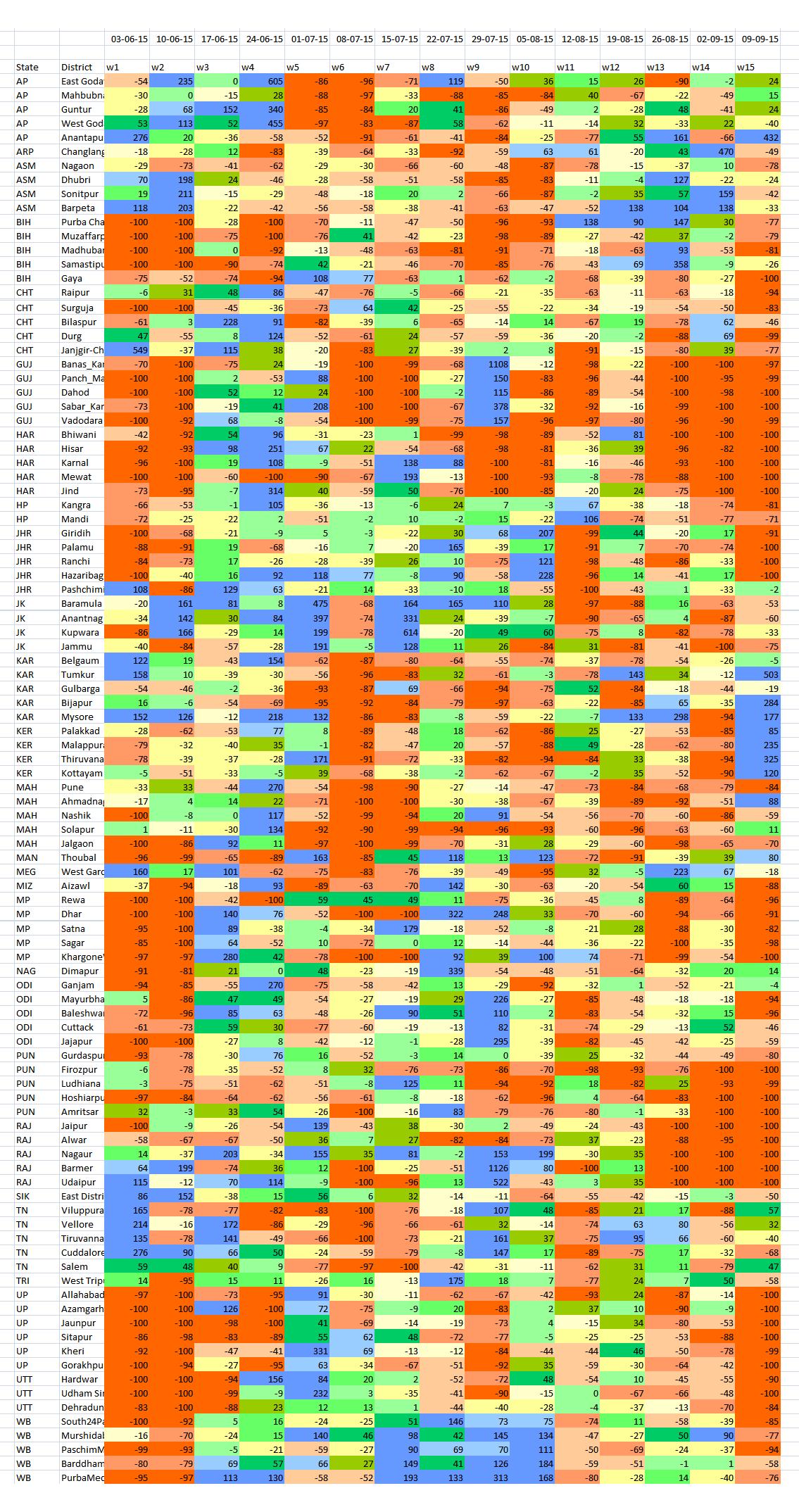
RG_ICP_100districts_table_20150918The detailed tabulation provided here is meant to provide guidance of where this may be done immediately – in the next two to four weeks – and how this can be done in future.

The table lists 100 districts each of which have readings 15 weeks of rainfall variation – the numbers are not rainfall in millimetres (mm) but the variation in per cent from the long-term normal for that district for that week. The colour codes for each district’s week cell are the same as those used for the new 11-grade rainfall categorisation.

The districts are chosen on the basis of the size of their rural populations (calculated for 2015). Thus Purba Champaran in Bihar, Bhiwani in Haryana, Rewa in Madhya Pradesh and Viluppuram in Tamil Nadu are the districts in those states with the largest rural populations.

In this way, the effect of rainfall variability, from Week 1 (which ended on 3 June) to Week 15 (which ended on 9 September), in the districts with the largest rural populations can be analysed. Because a large rural population is also a large agricultural population, the overall seasonal impact on that district’s agricultural output can also be inferred.

The distribution of the districts is: six from Uttar Pradesh; five each from Andhra Pradesh, Bihar, Chhattisgarh, Gujarat, Haryana, Jharkhand, Karnataka, Maharashtra, Madhya Pradesh, Odisha, Punjab, Rajasthan, Tamil Nadu and West Bengal; four each from Assam, Jammu and Kashmir, and Kerala; three from Uttarakhand; two from Himachal Pradesh; one each from Arunachal Pradesh, Manipur, Meghalaya, Mizoram, Nagaland, Sikkim and Tripura.

Using the new 11-grade rainfall categorisation, a normal rainweek is one in which the rainfall is between +10% more and -10% less for that week. The overview for this group of 100 districts, only 11 have had five or more normal weeks of rain out of 15 weeks. In alarming contrast, there are 77 districts which have had three or fewer normal weeks of rain – that is, more than three-fourths of these most populous districts. Half the number (51 districts) have had two, one or no normal weeks of rain. And 22 of these districts have had only one or no normal weeks of rain.

From this group of 100 most populous (rural population) districts Gorakhpur in Uttar Pradesh and Nagaon in Assam have had the most deficit rainweeks, tallying 13, out of the 15 tabulated so far. There are ten districts which have had 12 deficit rainweeks out of 15 and they are (in decreasing order of rural population): Muzaffarpur (Bihar), Pune and Jalgaon (Maharashtra), Surguja (Chhattisgarh), Panch Mahals and Vadodara (Gujarat), Firozpur (Punjab), Thiruvananthapuram (Kerala), Hoshiarpur (Punjab) and Mewat (Haryana).

– Rahul Goswami

Filed Under: Monsoon 2015, Reports & Comment Tagged With: agriculture, district, IMD, India, monsoon, population, rain, rural, urban, water

Celsius surprises in 57 cities

May 21, 2015 by Climate portal editor Leave a Comment

ICP_57_cities_temp_top

The middle of February is when the chill begins to abate. The middle of May is when the monsoon is longed for. In our towns, district headquarters and cities, that climatic journey of 90 days is one of a steady rise in the reading of the temperature gauge, from the low 20s to the mid 30s.

This large panel of 90 days of daily average temperatures shows, in 57 ways, the effects of the rains that almost every district has experienced during the last two months. For each city, the curved line is the long period ‘normal’ for these 90 days, based on daily averages. Also for each city, the second line which swings above and below the ‘normal’ is the one that describes the changes in its daily average from February to May 2015.

[You can download (1.52MB) a full resolution image of the panel here.]

Where this second line crosses to rise above the normal, the intervening space is red, where it dips below is coloured blue. The patches of red or blue are what tell us about the effects of a lingering winter, or rains that have been called ‘unseasonal’ but which we think signal a shift in the monsoon patterns.

Amongst the readings there is to be found some general similarities and also some individual peculiarities. Overall, there are more blue patches than there are red ones, and that describes how most of the cities in this panel have escaped (till this point) the typical heat of April and May. The second noteworthy general finding is that these blue patches occur more frequently in the second half of the 90 days, and so are the result of the rainy spells experienced from March to early May.

Hisar (in Haryana) has remained under the normal temperature line for many more days than above or near it. So have Gorakhpur (Uttar Pradesh), Pendra (Chhattisgarh), Ranchi (Jharkhand), Nagpur (Maharashtra) and Jharsuguda (Odisha).

On the other hand in peninsular and south India, the below ‘normal’ daily average temperature readings are to be found in the latter half of the time period, coinciding with the frequent wet spells. This we can see in Kakinada, Kurnool and Anantapur (Andhra Pradesh), Bangalore, Gadag and Mangalore (Karnataka), Chennai, Cuddalore and Tiruchirapalli (Tamil Nadu) and Thiruvananthapuram (Kerala). [A zip file with the charts for all 57 cities is available here (1.2MB).]

What pattern will the next 30 days worth of temperature readings follow? In four weeks we will update this bird’s eye view of city temperatures, by which time monsoon 2015 should continue to give us more blues than reds. [Temperature time series plots are courtesy the NOAA Center for Weather and Climate Prediction.]

Filed Under: Current, Monsoon 2015, Reports & Comment Tagged With: Anantapur, Andhra Pradesh, Bangalore, Chennai, Chhattisgarh, city, climate, Cuddalore, Gadag, Gorakhpur, India, Jharkhand, Jharsuguda, Kakinada, Karnataka, Kerala, Kurnool, Maharashtra, Mangalore, monsoon, Nagpur, Odisha, Ranchi, Tamil Nadu, temperature, Thiruvananthapuram, Tiruchirapalli, town, urban, Uttar Pradesh

The IPCC’s India voice?

November 4, 2014 by Climate portal editor Leave a Comment

RG_ICP_IPCC2_20141104

The three working groups of the Intergovernmental Panel on Climate Change (IPCC) Fifth Assessment Report have occupied, for months on end, 837 of what the IPCC method calls ‘authors’. Most are scientists, with considerable experience in the areas of atmospheric, cryospheric, oceanographic or bio-geochemical sciences, but they are also social scientists and economists, administrators and statisticians.

Insofar as the ‘inter-governmental’ aspect of the IPCC is concerned, they have been drawn from a number of countries, and have usually classified themselves by country of residence and work (though some are classified by institution too, especially when that institution is directly or indirectly a United Nations institute). All have contributed – as coordinating lead author, lead author, review editor, or for a technical summary – to the many voluminous chapters that have taken shape as the Fifth Assessment Report.

Amongst this corps is India’s contribution to the effort, with 33 authors. This is not a small group, for there are 43 from China and 31 from Japan (these groups exclude those of Indian or Asian origin who are authors but who have identified themselves under other countries and institutions). Compared with the contingents from western Europe, the USA and the OECD countries (as a bloc), Asia may be seen to be under-represented (and Africa very much more so) in the IPCC evidence examining and report writing process but that is a separate matter.

RG_ICP_IPCC2_20141104_2What is germane to us is: has the IPCC process and method an Indian outlook that will be of as much utility at home as it has been to the inter-governmental effort? A short answer will be ‘no’ to the first query (because it is about science, evidence and international consensus and not about national priorities) and ‘don’t know’ to the second. There is no reason why a ‘don’t know’ should persist, as the Fifth Assessment process comes to a close, for the size of India’s population and economy, and the likely effects climate change has and is forecast to have on our 35 states and union territories ought to have turned climate change into common currency wherever planning is carried out and implemented.
But that is not so, despite 33 Indian authors having contributed to the IPCC Fifth Assessment. They represent a far greater number who are, in one or more ways, concerned with the impacts of climate change in India and with our responses to those changes. What has seemed to have stood in the way of an Indian and a Bharatiya view of climate change is the predilection by academicians (particularly from those used to working in inter-governmental and UN circles) to propagate at home the language of international climate negotiation rather than direct statements and questions that have to do with conditions on the ground in Madhya Maharashtra or Assam or Jharkhand.

Consider one amongst the several quotes lent to our media following the release of the Fifth Assessment Synthesis Report: “The IPCC synthesis report suggests a way of thinking about climate change that is deeply relevant to India. There is a complex two way relationship between sustainable development and climate change: climate policies should support not undermine sustainable development; but limiting the effects of climate change is necessary to achieve sustainable development. The report clearly states there are limits to adaptation. For India the message is that while adaptation is critical, keeping the pressure on for global mitigation is also key.”

Unfortunately for any administrator (such as a district collector or a watershed mapper or the superintendent of a regional referral hospital) such a statement says very little. It neither draws out any interest in further understanding the effects of climate change in the districts and towns of Bharat, nor does it help provide a personal context to what is unquestionably a reporting process of vital importance to us all.

Part of the problem is the UN/inter-governmental language of negotiation that has become the norm when speaking about (or writing about, for several of these 33 contribute articles to the media regularly) climate change. As busy people, they may expect the media to interpret into popular idiom, simplify and amplify, and otherwise lend local colour to their prose. If so, they are plain wrong, for the responsibility to do so is theirs, not the media’s.

RG_ICP_IPCC2_20141104_3

Is there a demand for explanation that is true to context? There is practically none, and that is why this group (the 33 Indian contributors to the Fifth Assessment report) must be called upon to translate the IPCC method for local administrations. This is important as there are several worlds which do not intersect. That of the IPCC and the sophisticated cohort of institutions which have contributed to the Fifth Assessment report on the one hand, whereas everyday workaday life in Bharat’s 7,935 towns, cities and metropolises proceeds for many tens of millions with or without the magisterial pronouncements of the IPCC’s working groups. There will always be a gulf between these worlds, but there must also be bridges, and currently there are far too few.

Who can be called upon? Here is the current roll call. There are: Krishna Mirle Achutarao, Indian Institute of Technology; Pramod Aggarwal, CGIAR Research Program on Climate Change, Agriculture, and Food Security; Govindasamy Bala, Indian Institute of Science; Suruchi Bhadwal, The Energy and Resources Institute; Abha Chhabra, Indian Space Research Organisation; Pradeep Kumar Dadhich, Deloitte Touche Tohmatsu India Pvt. Ltd.; Purnamita Dasgupta, Institute of Economic Growth, University of Delhi Enclave; Navroz Dubash, Centre for Policy Research; Varun Dutt, Indian Institute of Technology; Amit Garg, Indian Institute of Management, Ahmedabad; Prashant Goswami, CSIR Centre for Mathematical Modelling and Computer Simulation; Anil Kumar Gupta, Wadia Institute of Himalayan Geology; Shreekant Gupta, University of Delhi; Sujata Gupta, Asian Development Bank (ADB); and Krishna Kumar Kanikicharla, Indian Institute of Tropical Meteorology.

Furthermore, there are: Arun Kansal, TERI University; Surender Kumar, University of Delhi; Ritu Mathur, The Energy & Resources Institute (TERI); Harini Nagendra, Ashoka Trust for Research in Ecology and the Environment (ATREE); Kirit S Parikh, Integrated Research and Action for Development (IRADe); Jyoti Parikh, Integrated Research and Action for Development (IRADe); Himanshu Pathak, Indian Agricultural Research Institute; Anand Patwardhan, Indian Institute of Technology-Bombay; Rengaswamy Ramesh, Physical Research Laboratory; Nijavalli H. Ravindranath, Indian Institute of Science; Aromar Revi, Indian Institute for Human Settlements; Joyashree Roy, Jadavpur University; Ambuj Sagar, Indian Institute of Technology Delhi; S. K. Satheesh, Indian Institute of Science; Priyadarshi R. Shukla, Indian Institute of Management, Ahmedabad; Eswaran Somanathan, Indian Statistical Institute, Delhi; Geetam Tiwari, Indian Institute of Technology; and Alakkat Unnikrishnan, National Institute of Oceanography. Who amongst these will stand up in the talukas and in the melee of our class II towns for Bharat?

– Rahul Goswami

Filed Under: Blogs Tagged With: AR5, Bharat, Climate Change, district, India, IPCC, policy, science, State, tehsil, town, UN, United Nations, urban

The ‘Better Growth, Better Climate’ report

September 18, 2014 by Climate portal editor Leave a Comment

ICP_New_Climate_Economy_201409

‘Better Growth, Better Climate: The New Climate Economy Report’ has just been released by the Global Commission on the Economy and Climate, which was set up to examine whether it is possible to achieve lasting economic growth while also tackling the risks of climate change.

The report “seeks to inform economic decision-makers in both public and private sectors, many of whom recognise the serious risks caused by climate change, but also need to tackle more immediate concerns such as jobs, competitiveness and poverty”.

The report’s conclusion is that “countries at all levels of income now have the opportunity to build lasting economic growth at the same time as reducing the immense risks of climate change”. This is made possible, it has said, by structural and technological changes unfolding in the global economy and opportunities for greater economic efficiency. The capital for the necessary investments is available, and the potential for innovation is vast.

“The next 15 years will be critical, as the global economy undergoes a deep structural transformation. It will not be ‘business as usual’. The global economy will grow by more than half, a billion more people will come to live in cities, and rapid technological advance will continue to change businesses and lives. Around US$90 trillion is likely to be invested in infrastructure in the world’s urban, land use and energy systems. How these changes are managed will shape future patterns of growth, productivity and living standards.”

According to the Global Commission on the Economy and Climate, the next 15 years of investment will also determine the future of the world’s climate system. “Without stronger action in the next 10-15 years, which leads global emissions to peak and then fall, it is near certain that global average warming will exceed 2°C, the level the international community has agreed not to cross”.

Future economic growth does not have to copy the high-carbon, unevenly distributed model of the past, is the message from the report. “There is now huge potential to invest in greater efficiency, structural transformation and technological change in three key systems of the economy.”

The Commission’s work has been conducted by a partnership of eight research institutes: World Resources Institute (WRI), Climate Policy Initiative (CPI), Ethiopian Development Research Institute (EDRI), Global Green Growth Institute (GGGI), Indian Council for Research on International Economic Relations (ICRIER), LSE Cities, Stockholm Environment Institute (SEI) and Tsinghua University.

Filed Under: Reports & Comment Tagged With: cities, Climate Change, climate economy, energy, global commission, ICRIER, land use, LSE, Stockholm Environment Institute, Tsinghua, urban, World Resources Institute

Climate change is not the only villain

September 11, 2014 by Climate portal editor Leave a Comment

A woman weeps at the site of her home, devastated by floods in Kuppar village near Jammu, in Jammu and Kashmir, India. Photo: Thomson Reuters Foundation / Ashutosh Sharma

A woman weeps at the site of her home, devastated by floods in Kuppar village near Jammu, in Jammu and Kashmir, India. Photo: Thomson Reuters Foundation / Ashutosh Sharma

About 200 kilometres separates Srinagar, in the valley of Kashmir in India, from the wide and flat northern plains of Pakistan’s Punjab province, the land between Gujranwala and Sialkot. The river that links these two regions, on either side of the border between two countries, is the Jhelum and its many mountain-fed tributaries. From early September, rains that are torrential in volume and frequency for the region steadily fed the streams, swelled the rivers and then rushed through the settlements and towns of northern Pakistan and India.

On both sides of the Pakistan-India border the scene is depressingly similar. The toll of the dead will not be known until the waters drain, and even then will be estimates, as they always are. Until two days ago, 220 or 230 was the number of lives reported lost in both countries. The number of lives disrupted, displaced and reduced to misery is far greater – more than 100,000 have been rescued by the Indian Army in the state of Jammu and Kashmir. In Pakistan too it has been its army that has performed extraordinary feats of rescue and provided relief when every other administrative mechanism failed, but as the waters continued to gather in volume and speed, the September floods are already estimated to have affected more than a million in Pakistan.

A couple wades through a flooded road after heavy rains in Lahore, Pakistan, on 4 September 2014. Photo: Reuters / Mohsin Raza

A couple wades through a flooded road after heavy rains in Lahore, Pakistan, on 4 September 2014. Photo: Reuters / Mohsin Raza

There has been mourning and resignation, for lives lost and for homes destroyed, but there is also anger in both Pakistan’s Punjab and India’s Jammu and Kashmir. Economic need and the search for livelihoods has brought migrants into urban settlements, while older and more established households have sought to better their standards of living. Overlooked every single year, despite at least one emergency caused by natural phenomena, has been implementing the regulations needed for fast-growing settlements in flood-prone regions. Both countries have national disaster management authorities, and yet the complaint most commonly heard by those escaping floodwaters and by those seeking relief is: where was the warning and where was the help when we needed it?

The very recent history in India (the catastrophic rain and landslides in Uttarakhand in 2013) and in Pakistan (the record flooding of 2010) of natural disasters appears not to have led to the institutionalisation of a culture that is willing to learn from past misfortune. In both countries, media has reported scores of survivors praising swift and selfless action by the armed forces and at the same time condemning inaction by local and provincial authorities.

Climate change and its impacts has become a catch-all villain for the record floods and the devastation they have caused (and continue to). But amongst the complex menu of reasons for the failure of systems and responses, several others stand out in bolder relief. The encroachment by galloping urbanisation of river catchment areas, unregistered and illegal construction (both residential and commercial) along river banks and the blind conversion of wetlands into agricultural lands has, in both countries, turned historically familiar floods into fearsome deathtraps.

When the waters ebb and families can reunite, both Pakistan and India must together confront the real reasons behind the destruction and toll wrought by the floods of September 2014.

Filed Under: Latest, Monsoon 2014 Tagged With: army, Chenab, disaster, flood, Gujranwala, India, Jhelum, Kashmir, Lahore, Pakistan, Punjab, river, Sialkot, Srinagar, urban

Indiaclimate twitter

Tweets by @Indiaclimate

Notable

Between contemplation and climate

Whether or not the USA, Europe, the Western world, the industrialised Eastern world (China, Japan, South Korea, Taiwan), adhere to or not their paltry promises about being more responsible concerning the factors that lead to climate change, is of very little concern to us. We have never set any store by international agreements on climate […]

The ‘Hindu’, ignorant about weather and climate, but runs down IMD

We find objectionable the report by ‘The Hindu’ daily newspaper accusing the India Meteorological Department of scientific shortcoming (‘IMD gets its August forecast wrong’, 1 September 2016). The report claims that the IMD in June 2016 had forecast that rains for August would be more than usual but that the recorded rain was less than […]

dialogue

  • Misreading monsoon | Resources Research on Misreading monsoon
  • Satish on A tribute to the weathermen of Bharat
  • Climate portal editor on A tribute to the weathermen of Bharat
  • Climate portal editor on A tribute to the weathermen of Bharat
  • Climate portal editor on A tribute to the weathermen of Bharat

Categories

Copyright © 2025 indiaclimateportal.org.