The India Climate Observatory

Commentary, action and research on climate and development in India

  • Home
  • About
  • Monsoon 2018
  • Current
  • Bulletin
  • Contact
  • Announcements

Visualising the December ice-box

January 2, 2016 by Climate portal editor 1 Comment

ICP_20160102

Between 10 and 15 December 2015, minimum temperatures all over northern India and Pakistan, in particular in the Hindu Kush and western Himalaya (including the state of Jammu and Kashmir) dropped sharply. The cold and strong north-westerly winds blowing in from the distant Central Asian region during this period of December deepened the persistent chill.
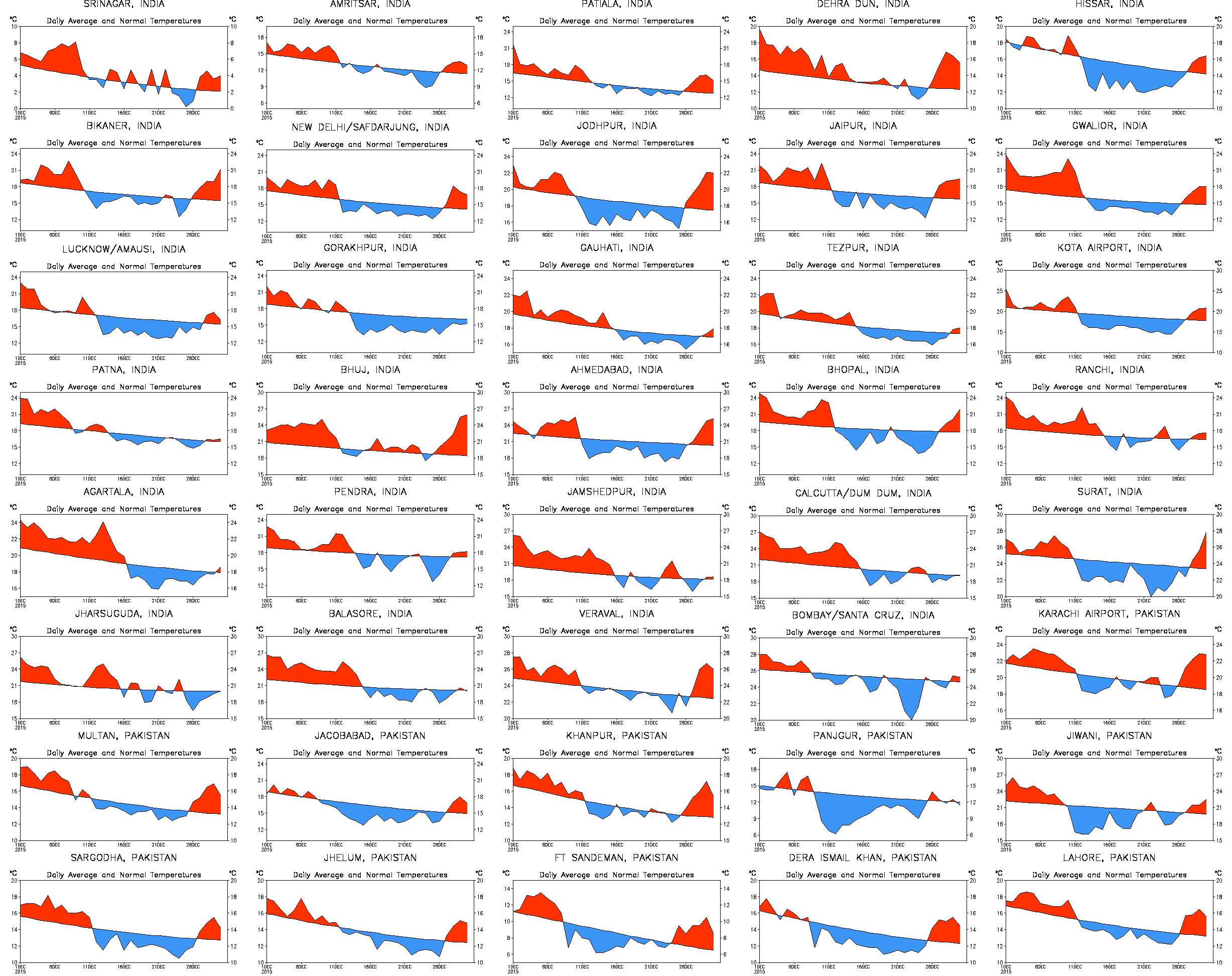
This panel of the 30-day temperature charts for 40 cities shows the sudden dip all experienced from around 10 December. Original charts are from the NOAA Center for Weather and Climate Prediction and reassembled for this panel.

This panel of the 30-day temperature charts for 40 cities shows the sudden dip all experienced from around 10 December. Original charts are from the NOAA Center for Weather and Climate Prediction and reassembled for this panel.

The cold wave was also experienced in the north-western region – including Rajasthan, Gujarat and adjacent north Maharashtra as far south as Mumbai. From 10 December until 27 and 28 December, unusually cold conditions gripped entire agro-ecological regions – the north Gujarat plain together with the Kathiawad peninsula, the Aravalli ranges and the east Rajasthan uplands, the Ganga-Yamuna Doab, Rohilkhand and the Avadah plain, the Madhya Bharat plateau and the Bundelkhand uplands, and the Central (or Malwa) highlands.

These 30-day temperature charts shows the sudden dip in minimum for 40 cities from 9 and 10 December, and the setting in of cold conditions which continued for two weeks thereafter. During this time, the higher reaches of Kashmir Valley received snowfall, New Delhi recorded minimums of around 5 Celsius with the maximums being two to three degrees below normal, Amritsar in Punjab was at 2 Celsius while Ludhiana and Patiala recorded between 4 and 6 Celsius. Churu in Rajasthan recorded a low of 3 Celsius and Mt Abu, at an altitude of 1,200 metres was just below 0 Celsius. State capital Jaipur recorded a minimum 6 Celsius.

Filed Under: Latest Tagged With: cold wave, Delhi, Gujarat, Himalaya, Hindu Kush, India, Pakistan, Punjab, Rajasthan, winter

Climate change is not the only villain

September 11, 2014 by Climate portal editor Leave a Comment

A woman weeps at the site of her home, devastated by floods in Kuppar village near Jammu, in Jammu and Kashmir, India. Photo: Thomson Reuters Foundation / Ashutosh Sharma

A woman weeps at the site of her home, devastated by floods in Kuppar village near Jammu, in Jammu and Kashmir, India. Photo: Thomson Reuters Foundation / Ashutosh Sharma

About 200 kilometres separates Srinagar, in the valley of Kashmir in India, from the wide and flat northern plains of Pakistan’s Punjab province, the land between Gujranwala and Sialkot. The river that links these two regions, on either side of the border between two countries, is the Jhelum and its many mountain-fed tributaries. From early September, rains that are torrential in volume and frequency for the region steadily fed the streams, swelled the rivers and then rushed through the settlements and towns of northern Pakistan and India.

On both sides of the Pakistan-India border the scene is depressingly similar. The toll of the dead will not be known until the waters drain, and even then will be estimates, as they always are. Until two days ago, 220 or 230 was the number of lives reported lost in both countries. The number of lives disrupted, displaced and reduced to misery is far greater – more than 100,000 have been rescued by the Indian Army in the state of Jammu and Kashmir. In Pakistan too it has been its army that has performed extraordinary feats of rescue and provided relief when every other administrative mechanism failed, but as the waters continued to gather in volume and speed, the September floods are already estimated to have affected more than a million in Pakistan.

A couple wades through a flooded road after heavy rains in Lahore, Pakistan, on 4 September 2014. Photo: Reuters / Mohsin Raza

A couple wades through a flooded road after heavy rains in Lahore, Pakistan, on 4 September 2014. Photo: Reuters / Mohsin Raza

There has been mourning and resignation, for lives lost and for homes destroyed, but there is also anger in both Pakistan’s Punjab and India’s Jammu and Kashmir. Economic need and the search for livelihoods has brought migrants into urban settlements, while older and more established households have sought to better their standards of living. Overlooked every single year, despite at least one emergency caused by natural phenomena, has been implementing the regulations needed for fast-growing settlements in flood-prone regions. Both countries have national disaster management authorities, and yet the complaint most commonly heard by those escaping floodwaters and by those seeking relief is: where was the warning and where was the help when we needed it?

The very recent history in India (the catastrophic rain and landslides in Uttarakhand in 2013) and in Pakistan (the record flooding of 2010) of natural disasters appears not to have led to the institutionalisation of a culture that is willing to learn from past misfortune. In both countries, media has reported scores of survivors praising swift and selfless action by the armed forces and at the same time condemning inaction by local and provincial authorities.

Climate change and its impacts has become a catch-all villain for the record floods and the devastation they have caused (and continue to). But amongst the complex menu of reasons for the failure of systems and responses, several others stand out in bolder relief. The encroachment by galloping urbanisation of river catchment areas, unregistered and illegal construction (both residential and commercial) along river banks and the blind conversion of wetlands into agricultural lands has, in both countries, turned historically familiar floods into fearsome deathtraps.

When the waters ebb and families can reunite, both Pakistan and India must together confront the real reasons behind the destruction and toll wrought by the floods of September 2014.

Filed Under: Latest, Monsoon 2014 Tagged With: army, Chenab, disaster, flood, Gujranwala, India, Jhelum, Kashmir, Lahore, Pakistan, Punjab, river, Sialkot, Srinagar, urban

Indiaclimate twitter

Tweets by @Indiaclimate

Notable

Between contemplation and climate

Whether or not the USA, Europe, the Western world, the industrialised Eastern world (China, Japan, South Korea, Taiwan), adhere to or not their paltry promises about being more responsible concerning the factors that lead to climate change, is of very little concern to us. We have never set any store by international agreements on climate […]

The ‘Hindu’, ignorant about weather and climate, but runs down IMD

We find objectionable the report by ‘The Hindu’ daily newspaper accusing the India Meteorological Department of scientific shortcoming (‘IMD gets its August forecast wrong’, 1 September 2016). The report claims that the IMD in June 2016 had forecast that rains for August would be more than usual but that the recorded rain was less than […]

dialogue

  • Misreading monsoon | Resources Research on Misreading monsoon
  • Satish on A tribute to the weathermen of Bharat
  • Climate portal editor on A tribute to the weathermen of Bharat
  • Climate portal editor on A tribute to the weathermen of Bharat
  • Climate portal editor on A tribute to the weathermen of Bharat

Categories

Copyright © 2025 indiaclimateportal.org.