The India Climate Observatory

Commentary, action and research on climate and development in India

  • Home
  • About
  • Monsoon 2018
  • Current
  • Bulletin
  • Contact
  • Announcements

Being prudent about forecasts

June 3, 2015 by Climate portal editor Leave a Comment

ICP_pre-monsoon_seasons_2011-15_sm

The Earth System Science Organisation (ESSO), Ministry of Earth Sciences (MoES) and the India Meteorological Department (IMD) released their second long range forecast for monsoon 2015 on 2 June. The ‘headline’ message is that rainfall for the June to September monsoon season is very likely to be 88% of what is normal for the season.

The forecast has been seized upon by various quarters as having serious implications for the production of crop staples (and therefore for food security), for farmers’ livelihoods, for consumer prices and for the availability of water. These are all valid and important aspects that depend entirely or substantially upon the summer monsoon.

But, the IMD, the ESSO and the MoES do not make statements and forecasts on these aspects. They are concerned with what the climatological data and signs point to, and that is what they have told us. How the forecast relates to important aspects of food, farm incomes, water resources and food stocks relies on interpretations. Our advice – to the media, to government agencies and to the private sector – is to go slow on drawing conclusions and when conclusions are required, to make them incrementally.

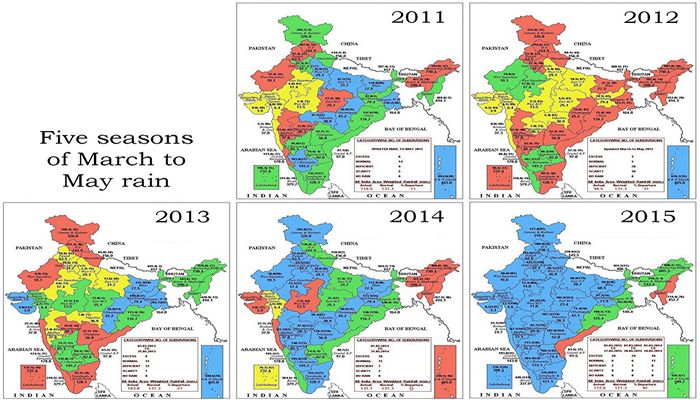
The wettest pre-monsoon season (March to May) for five years.

The wettest pre-monsoon season (March to May) for five years.

Using the handy graphic here, (887KB) we also point out that the pre-monsoon season (March to May) for 2015 has been the wettest in five years. In several meteorological sub-divisions, excess rain has been recorded during this pre-monsoon season. In several districts, the annual rainfall total has already been reached, even before the typical monsoon season of June to September.

This ought to be warning enough to us to be sparing with deciding how forecasts will affect us. The ESSO, IMD and MoES have repeated, in their second long range forecast, that 2015 is an El Niño year which only means that as this sea temperature phenomenon waxes and wanes though the remainder of 2015, so too will the monsoon system react.

It is best to judge our Indian summer monsoon a week at a time, keeping in mind crop calendars and how much water our reservoirs hold. It is always prudent to take precautions such as rationing water (even when it is raining), especially in towns and cities. Likewise, district administrations will do well to assess their local supplies of food staples and match these figures with what food staples their districts are likely to produce during a monsoon whose reliability has now been written off.

The second long range forecast for monsoon 2015 is available here, and the Hindi text can be found here.

Filed Under: Monsoon 2015, Reports & Comment Tagged With: 2015, climate, consumer price, crop, El Nino, farm, food stock, forecast, IMD, India, meteorology, monsoon, sea surface temperature, water

It’s to be a 93% monsoon says the IMD

April 22, 2015 by Climate portal editor 1 Comment

RG_ICP_IMD_forecast_20150422

The India Meteorological Department has just released it’s long-awaited forecast for the 2015 Indian monsoon. In terms of the quantity of rainfall over the duration of the monsoon season (June to September) the IMD has said it will be 93% of the ‘Long Period Average’. This average is based on the years 1951-2000.

What this means is the ‘national’ average rainfall over the monsoon season for India is considered to be 89 centimetres, or 890 millimetres. So, based on the conditions calculated till today, the ‘national’ average rainfall for the June to September monsoon season is likely to be 830 millimetres.

There are caveats and conditions. The first is that the 93% forecast is to be applied to the long period average for each of the 36 meteorological sub-divisions, and a ‘national average’ does not in fact have much meaning without considerable localisation. The second is that the forecasting methodology itself comes with a plus-minus caution. There is “a model error of ± 5%” is the IMD’s caution.

This first forecast and the model that the forecast percentage has emerged from are thanks to the efforts of the Earth System Science Organization (ESSO), under the Ministry of Earth Sciences (MoES), and the India Meteorological Department (IMD), which is the principal government agency in all matters relating to meteorology. This is what the IMD calls a first-stage forecast.

IMD_categories_201504As with all complex models, this one comes with several considerations. The ESSO, through the Indian Institute of Tropical Meteorology (IITM, which is in Pune), also runs what it calls an ‘Experimental Coupled Dynamical Model Forecasting System’. According to this, the monsoon rainfall during the 2015 monsoon season (June to September) averaged over India “is likely to be 91% ±5% of long period model average”. (The IMD forecast is available here, and in Hindi here.)

This is a lower figure than the 93% headline issued by the IMD. This too should be read with care as there are five “category probability forecasts” that are calculated – deficient, below normal, normal, above normal and excess. Each is accompanied by a forecast probability and a climatological probability (see the table). The maximum forecast probability of 35% is for a below normal monsoon, while the maximum climatological probability is for a normal monsoon.

As before, time will tell and the IMD will issue its second long range forecast in June 2015. Our advice to the Ministry of Earth Sciences and to the IMD is to issue its second long range forecast a month from now, in May, and also to confirm these forecasts two months hence in June, when monsoon 2015 will hopefully be active all over the peninsula.

Filed Under: Monsoon 2015, Reports & Comment Tagged With: 2015, climate, climatology, earth science, ESSO, forecast, IMD, India, meteorology, monsoon, weather

India braces for cyclone Hudhud

October 11, 2014 by Climate portal editor Leave a Comment

Insat-3D’s view of the path inland of Hudhud at 1730 IST (5:30pm IST) on 12 October. The cyclonic storm is now moving north-northwest through Odisha into Jharkhand, Chhattisgarh and south Bihar. Image: IMD

Insat-3D’s view of the path inland of Hudhud at 1730 IST (5:30pm IST) on 12 October. The cyclonic storm is now moving north-northwest through Odisha into Jharkhand, Chhattisgarh and south Bihar. Image: IMD

Oct 14 – The Armed Forces have further stepped up their rescue and relief operations in the coastal areas of Andhra Pradesh and Odisha. The Press Information Bureau has reported that eight ‘composite’ Army teams have been deployed in Vishakhapatnam and another eight teams in Srikakulam.

Prime Minister Narendra Modi examining pictures of destruction caused by Cyclone HudHud, at Vizag Collectorate, on 14 October 2014. Image: PIB

Prime Minister Narendra Modi and Andhra Pradesh chief minister N Chandrababu Naidu examining pictures of destruction caused by Cyclone HudHud, at Vizag Collectorate, on 14 October 2014. Image: PIB

The Indian Air Force has deployed C-17, C130J, AN-32, IL-76, Mi-17 and Chetak aircraft and helicopters for rescue and relief work. A total of 120 tonnes of essential supplies have been airlifted to Visakhapatnam from Vijayawada and Rajamundry, while essential supplies have also been marshalled at the Naval airfield at Visakhapatnam. Until the evening of 14 October, 36 sorties were made towards relief operations. Two road clearance teams of Army have been employed in the north of Srikakulum district and the road between Achutapuram and Vizag has been cleared by the armed forces teams.

An aerial survey was conducted by C-130J of the IAF and P-8I of the Navy with satellite imagery having been used to assess the impact of cyclone Hudhud while coastal reconnaissance is being done by the Coast Guard. Additional Engineer Units of the Army are being flown to Visakhapatnam.

Oct 12 – The IMD has issued its evening alert on cyclone Hudhud. The 1700 IST (5:00pm IST) alert contains a heavy rainfall warning and a wind warning.

Heavy rainfall warning: Rainfall at most places with heavy (6.5-12.4 cm) to very heavy falls (12.5-24.4 cm) at a few places and isolated extremely heavy falls (>24.5 cm) would occur over West and East Godavari, Visakhapatnam, Vijayanagaram and Srikakulam districts of north Andhra Pradesh and Ganjam, Gajapati, Koraput, Rayagada, Nabarangpur, Malkangiri, Kalahandi, Phulbani districts of south Odisha during next 24 hrs. Rainfall would occur at most places with heavy to very heavy rainfall at isolated places over Krishna, Guntur and Prakasham districts of Andhra Pradesh and north Odisha during the same period. Rainfall at most places with heavy falls at a few places would occur over south Chattisgarh, adjoining Telangana and isolated heavy to very heavy falls over north Chattisgarh, east Madhya Pradesh, Jharkhand and Bihar.

Cyclone Hudhud will degrade into a severe cyclonic storm, then a cyclonic storm and by 13 October morning into a deep depression. Until 14 October it will continue to pose a danger with heavy rainfall and high winds. This IMD table explains why.

Cyclone Hudhud will degrade into a severe cyclonic storm, then a cyclonic storm and by 13 October morning into a deep depression. Until 14 October it will continue to pose a danger with heavy rainfall and high winds. This IMD table explains why.

Press Information Bureau distributes very useful railway helpline numbers.

Press Information Bureau distributes very useful railway helpline numbers.

Wind warning: Current gale wind speed reaching 130-140 kmph gusting to 150 kmph would decrease gradually to 100-110 kmph gusting to 120 kmph during next 3 hours and to 80-90 kmph during subsequent 6 hours over East Godavari, Visakhapatnam, Vizianagaram and Srikakulam districts of North Andhra Pradesh. Wind speed of 80-90 kmph gusting to 100 kmph would prevail over Koraput, Malkangiri, Nabarangpur and Rayagada districts during next 6 hrs and 50 to 60 kmph during subsequent 12 hrs. Squally wind speed reaching upto 55-65 kmph gusting to 75 kmph would also prevail along and off West Godavari and Krishna districts of Andhra Pradesh, Ganjam and Gajapati districts of Odisha, south Chattisgarh and adjoining districts of north Telangana during next 12 hours.

Andhra Pradesh helpline numbers here. (Thanks to Ankur Singh ‏@ankurzzzz)

Andhra Pradesh helpline numbers here. (Thanks to Ankur Singh ‏@ankurzzzz)

Odisha district control room phone numbers have been distributed thanks to eodisha.org.

They are: Mayurbhanj 06792 252759, Jajpur 06728 222648, Gajapati 06815 222943, Dhenkanal 06762 221376, Khurda 06755 220002, Keonjhar 06766 255437, Cuttack 0671 2507842, Ganjam 06811 263978, Puri 06752 223237, Kendrapara 06727 232803, Jagatsinghpur 06724 220368, Balasore 06782 26267, Bhadrak 06784 251881.

There are reports on twitter that the leading edge of cyclone Hudhud crossed the coast at around 1030 IST (0500 UTC). The reported maximum wind speed is just above 200 kmph which means the destructive force threatens structures too.

Strangely calm right Now. Everything outside is eerily quiet. We’re IN THE EYE of the storm now #Cyclone #Hudhud #Vizag #Visakhapatnam

— Deepa Ghosh (@deepaghosh2007) October 12, 2014

This tweet means the western ‘wall’ of the cyclone has now crossed completely – it has taken just under two hours. The eastern ‘wall’ crossing will now begin.

Cyclone #Hudhud hits the coast of Andhra Pradesh at Kailashgiri in Visakhapatnam. Live updates http://t.co/FQU6kZvVSR pic.twitter.com/YGzZYwIUpg

— Sudhan Rajagopal BJP (@BJPsudhanRSS) October 12, 2014

Cyclone #Hudhud makes landfall at Bheemunipatanam, slightly north of Vizag. #TVnews

— Saswat K Swain (@saswat28) October 12, 2014

Roofs of houses fly away like leaves, huge trees falling everywhere #Hudhud creating maximum destruction.

— Imran Baig (@imranbaig) October 12, 2014

Navy officials warn that there will be a lull in the storm at around 11.30 am, but the storm will again intensify after that for a few hours.
Zee News has a list of cancelled and curtailed trains.
At least 400,000 people have been evacuated from the coastal areas of Andhra Pradesh and Odisha states as authorities aimed for zero casualties.

Oct 11 -Where is Cyclone Hudhud and how fast is it moving towards land? The India Meteorological Department has said in its most recent alert – 1430/2:30pm on 11 October – that “the Very Severe Cyclonic Storm” is now about 260 kilometres south-east of Visakhapatnam and 350 km south-south-east of Gopalpur. IMD expects the cyclone to travel north-west and cross the coast of north Andhra Pradesh, near Visakhapatnam, by mid-morning on 12 October 2014.

The projected path of the cyclone and its outer rainbands, which in the case of Hudhud are around 80 km thick measured from the eye. Image: GDACS

The projected path of the cyclone and its outer rainbands, which in the case of Hudhud are around 80 km thick measured from the eye. Image: GDACS

Around 100,000 people have been evacuated in Andhra Pradesh to high-rise buildings, shelters and relief centres, with plans to move a total of 300,000 to safety. Authorities in Odisha said they were monitoring the situation and would, if necessary, move 300,000 people most at risk.

The evacuation effort was comparable in scale to the one that preceded Cyclone Phailin exactly a year ago, and which was credited with minimising the fatalities to 53. When a huge storm hit the same area 15 years ago, 10,000 people died.

Authorities have been stocking cyclone shelters with dry rations, water purification tablets and generators. They have opened up 24-hour emergency control rooms and dispatched satellite phones to officials in charge of vulnerable districts.

IMD’s table of wind speeds at the surface (sea level) brought by Hudhud. Note the exceptionally strong winds between 2330/11:30pm on 11 October and 1130/11:30am on 12 October.

IMD’s table of wind speeds at the surface (sea level) brought by Hudhud. Note the exceptionally strong winds between 2330/11:30pm on 11 October and 1130/11:30am on 12 October.

The AP government has cancelled leaves of employees and has asked everyone to remain on duty on the weekend.  In Vizag, where the cyclone is expected to make landfall, the administration has opened 175 shelters and moved close to 40,000 people from the coastal villages. In Srikakulam, people of 250 villages in 11 mandals which may be affected have been evacuated.

Vishakhapatnam, Bhimunipatnam, Chittivalasa and Konada are expected to face storm surges of over 1 metre. Source: GDACS

Vishakhapatnam, Bhimunipatnam, Chittivalasa and Konada are expected to face storm surges of over 1 metre. Source: GDACS

While human casualties are not expected due to the massive evacuation, power and telecommunication lines will be uprooted leading to widespread disruption. A warning has been issued that flooding and uprooted trees will cut off escape routes, national and state highways and traffic is being regulated to ensure that no one is caught in the flash floods caused by heavy rains.

Officials said that National Disaster Response Force teams have been strategically placed along the coast to be deployed wherever they are required. Railways has cancelled all trains passing through the three districts which are likely to be affected.

The IMD has issued a “Heavy Rainfall Warning” which has said that driven by the cyclonic winds, rainfall at most places along the AP and Odisha coast will be heavy (6.5–12.4cm) to very heavy (12.5–24.4 cm). These places include West and East Godavari, Visakhapatnam, Vijayanagaram and Srikakulam districts of north Andhra Pradesh and Ganjam, Gajapati, Koraput, Rayagada, Nabarangpur, Malkangiri, Kalahandi, Phulbani districts of south Odisha.

This panel of four images shows the wind patterns of the cyclone at different altitudes. Top left is at 1,000 millibars (mb) of atmospheric pressure which is around sea level, top right is at 850 mb which is at around 1,500 metres high, bottom left is at 700 mb which is at around 3,500 metres, and bottom right is at 500 mb which is at around 5,000 metres. The direction of the greenish lines shows the winds rushing into the cyclonic centre. The visualisations have been collected from the ‘earth.nullschool.net’, which visually processes global weather conditions forecast by supercomputers and updated every three hours.

This panel of four images shows the wind patterns of the cyclone at different altitudes. Top left is at 1,000 millibars (mb) of atmospheric pressure which is around sea level, top right is at 850 mb which is at around 1,500 metres high, bottom left is at 700 mb which is at around 3,500 metres, and bottom right is at 500 mb which is at around 5,000 metres. The direction of the greenish lines shows the winds rushing into the cyclonic centre. The visualisations have been collected from the ‘earth.nullschool.net’, which visually processes global weather conditions forecast by supercomputers and updated every three hours.

The India Meteorological Department said on the evening of 10 October that the “Very Severe Cyclonic Storm” is centered near latitude 15.0ºN and longitude 86.8ºE about 470 km east-southeast of Visakhapatnam and 520 km south-southeast of Gopalpur. This was the fix IMD had on the centre of the cyclone at 1430 IST on 10 October 2014.

Here are the salient points from news reports released during the afternoon of 10 October:

Cyclone Hudhud will cross the north Andhra Pradesh coast on October 12 and is expected to make landfall close to Visakhapatnam, according to the Cyclone Warning Centre (CWC) at Visakhapatnam. “It is forecast that Hudhud, which is already a severe cyclonic storm, will intensify into a very severe cyclonic storm in next 12 hours. Hudhud is likely to make landfall on October 12 close to Visakhapatnam,” said IMD’s Hyderabad centre.

Cyclone Hudhud has moved closer to the coast of Odisha and eight districts of the state are likely to be affected by it. The districts likely to be affected by the cyclone are Ganjam, Gajapati, Rayagada, Koraput, Malkangiri, Nabarangpur, Kalahandi and Kandhamal. All these districts have been provided with satellite phones for emergency and constant vigil was being maintained on the rivers like Bansadhara, Rusikulya and Nagabali as heavy rain is expected in southern districts.

With cyclone Hudhud fast approaching the states of Odisha, Andhra Pradesh and Telangana, Union Home Minister Rajnath Singh today spoke to the chief ministers of the three states on the steps being taken to deal with the situation. Odisha Chief Minister Naveen Patnaik sought satellite phones which could be used in case high-speed winds disturbed the telecommunication system.

According to the India Meteorological Department, the wind speeds of cyclone Hudhud will be less than what the east coast experienced during Phailin in October 2013. The wind speed during cyclone Phailin was nearly 210 kmph, which made the cyclone the second-strongest ever to hit India’s coastal region. The country had witnessed its severest cyclone in Odisha in 1999.

Frequent updates and advisories can also be found at GDACS – the Global Disaster Alert and Coordination System (a cooperation framework under the UN umbrella). GDACS provides real-time access to web-based disaster information systems and related coordination tools.

Cities that will directly be affected by cyclone Hudhud are Vishakhapatnam in Andhra Pradesh, Jagdalpur in Chhattisgarh, Vizianagaram in AP, Bhogapuram in AP, and Anakapalle in AP.

Filed Under: Current, Latest, Monsoon 2014 Tagged With: Andhra Pradesh, Bay of Bengal, Chandrababu Naidu, cyclone, cyclonic storm, disaster, emergency, evacuation, flood, Gajapati, Ganjam, Godavari, Hudhud, IMD, Kalahandi, Koraput, Malkangiri, Modi, Nabarangpur, Odisha, Phailin, Phulbani, Rayagada, relief, Srikakulam, storm, Vijayanagaram, Visakhapatnam

A report card on monsoon 2014

October 1, 2014 by Climate portal editor Leave a Comment

RG_ICP_districts_table_201410From the first week of June 2014 until the middle of September 2014, there have been floods and conditions equivalent to drought in many districts, and for India the tale of monsoon 2014 comes from a reading of individual districts, not from a national ‘average’ or a ‘cumulative’. [This article was published by the newspaper DNA.]

Despite the advances made by our agencies in weather forecasting and climate monitoring, the science of meteorology still remains to be effectively distilled so that it can be used by citizens and, wherever possible, expanded and given context by ground-based observation and recording. One sector in which this does take place – albeit at a level still far below its potential – is agriculture. The reason is clear: our crop staples (the cereals, pulses, vegetables and fruit) have their individual calendars for preparation, sowing, tending and harvesting.

This line chart tells some of the tale. It shows that for the first six weeks of monsoon 2014, most districts recorded rain below their 'normals' for those weeks. The lines are percentile lines; they tell us what percent of districts recorded how much rainfall in a monsoon week relative to their normals for that week. This chart does not show how much rain - it shows distance away from a weekly normal for districts. The left scale is a percentage - higher percentages indicate how far above normal districts recorded their rainfall, negative numbers show us how far below normal their rainfall was. The dates (the bottom scale) are for weeks ending on that date for which normals and departures from normal were recorded. The P_01 to P_09 lines are the percentiles (10th to 90th) of all districts in every week.

This line chart tells some of the tale. It shows that for the first six weeks of monsoon 2014, most districts recorded rain below their ‘normals’ for those weeks. The lines are percentile lines; they tell us what percent of districts recorded how much rainfall in a monsoon week relative to their normals for that week. This chart does not show how much rain – it shows distance away from a weekly normal for districts.
The left scale is a percentage – higher percentages indicate how far above normal districts recorded their rainfall, negative numbers show us how far below normal their rainfall was. The dates (the bottom scale) are for weeks ending on that date for which normals and departures from normal were recorded. The P_01 to P_09 lines are the percentiles (10th to 90th) of all districts in every week.

And so we have an agricultural meteorology system that faithfully and reliably informs ‘kisans’ and cultivators in 641 districts what to expect from the weather for the next week. Thanks to mobile phones, weather alerts and crop advisories are distributed in all our major languages to a portion of the farming households working on 138 million farm holdings, (of which 117 million are small). But this is still only a portion, and is far from adequate in distributing the results of the work of our earth scientists and field staff.

Moreover, every other sector of development requires such raw data and location-specific analysis: the Department of Rural Development, the National Rural Health Mission, the Nirmal Bharat Abhiyan (for drinking water and sanitation), the food-based programmes (like the mid-day meals) for which the availability of ingredients and their supply is the essence of their work, the Central Water Commission and the Central Ground Water Board, whose work it is to determine the water flows and balances in river sub-basins and watersheds (there are 3,257), and districts administrations (which administer 232,855 panchayats) and municipal councils alike which must implement relief measures when drought sets in or must ration supply when there are shortages. This is but a small list of agencies whose work is directly affected by the Indian summer monsoon and its activity where they work.

A dense network of weather stations (more of these are being automated every month, but every taluka still does not have one) is complemented by dedicated satellites which provides continuous coverage of the sub-continent, the northern Asian land mass, the surrounding oceans southwards until beyond the Tropic of Capricorn.

The typical IMD map of 'normal' rainfall measured by the meteorological sub-divisions. The detailed weekly tables give us a very different picture

The typical IMD map of ‘normal’ rainfall measured by the meteorological sub-divisions. The detailed weekly tables give us a very different picture

Methods to simply and accurately funnel this stream of real-time data and imagery are available, mostly at no cost, in order to aid local administrations, farmers and cultivators, and all citizens. It is this availability and relative simplicity of use (block-level weather forecasts for 72 hours are now available as local language apps on smartphones) that must be encouraged by the official agencies – for they simply do not have the persons to do so at the scale and detail required.

Consider the setting in early July 2014. India’s summer monsoon was already late, and where it was late but active it was weak (as shown by the chart). The indications from the central earth science agencies (including the India Meteorological Department), from the Indian Institute of Tropical Meteorology, from the National Centre for Medium Range Weather Forecasting were that it would be end-June before the summer monsoon system settles over central India and the western Gangetic plains. This did not happen for another two weeks, until six of the usual 16 monsoon weeks had passed.

When in mid-July more rainfall was recorded in the districts, even then, as the chart shows, only 50% of the districts reached their ‘normals’ for that week only. Thereafter, the volatility of rainfall set in and while for those in our towns and cities there was relief from the searing summer temperatures the rains did not assure sowing conditions for farmers and cultivators, nor did it add, in July, to the stores of water in major and minor reservoirs.

That is why the IMD’s outdated and stodgy public outreach practice must be overhauled, completely. The bland map (see example) of sub-divisions is of little use when what we want to know pertains to tehsil and town. The Met Department’s rain adequacy categories must be replaced too by measures that are geared towards aiding alerts and advisories – ‘normal’ is rainfall up to +19% above a given period’s average and also down to -19% from that same average, a range that can make or break the efforts of a horticulturist.

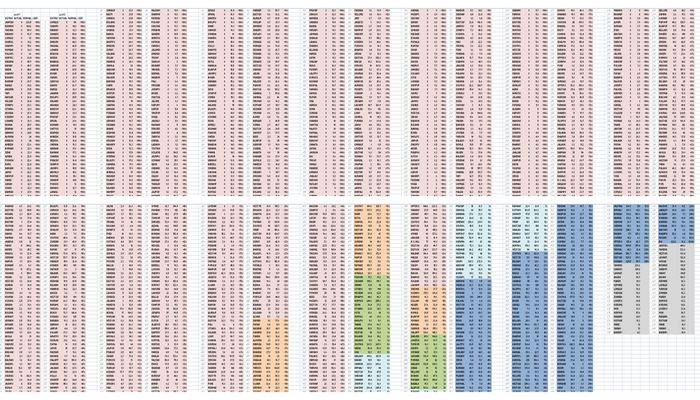
This table illustrates the trend of weekly rainfall in 40 districts. These districts are selected as being home to the largest rural populations, two from the 20 major states (by population). The numbers by week and district describe how far from a 'normal' the recorded rainfall for that week was. Several overall observations stand out. Districts with weeks coloured light rose dominate, for these show those that received much less rain than they should have. Districts with a shade of deeper blue are the next most frequent category, and those received excess rain. Taken together, this tells us that extremes - very much less or more - were common for this group of districts in India with large rural populations. We can see the prolonged dry spells for districts in Haryana and Punjab; likewise the absence of rain for the first six monsoon weeks in Gujarat and Maharashtra; are examples of wide swings around weekly 'normal' in Giridih (Jharkhand), Muzaffarpur (Bihar), Haridwar (Uttarakhand), Mandi (Himachal Pradesh), Viluppuram (Tamil Nadu), and Mahbubnagar (Andhra Pradesh). The weeks ending 20 August in Bihar and the weeks ending September 3 and 10 in Jammu and Kashmir immediately stand out - the Kosi had breached its banks in Bihar and the Chenab submerged Srinagar and Jammu.

This table illustrates the trend of weekly rainfall in 40 districts. These districts are selected as being home to the largest rural populations, two from the 20 major states (by population). The numbers by week and district describe how far from a ‘normal’ the recorded rainfall for that week was.
Several overall observations stand out. Districts with weeks coloured light rose dominate, for these show those that received much less rain than they should have. Districts with a shade of deeper blue are the next most frequent category, and those received excess rain. Taken together, this tells us that extremes – very much less or more – were common for this group of districts in India with large rural populations.
We can see the prolonged dry spells for districts in Haryana and Punjab; likewise the absence of rain for the first six monsoon weeks in Gujarat and Maharashtra; are examples of wide swings around weekly ‘normal’ in Giridih (Jharkhand), Muzaffarpur (Bihar), Haridwar (Uttarakhand), Mandi (Himachal Pradesh), Viluppuram (Tamil Nadu), and Mahbubnagar (Andhra Pradesh). The weeks ending 20 August in Bihar and the weeks ending September 3 and 10 in Jammu and Kashmir immediately stand out – the Kosi had breached its banks in Bihar and the Chenab submerged Srinagar and Jammu.

Likewise, excess is +20% and more, deficient is -20% to -59% and scanty is -60% to -99%. To illustrate how misleading these categories can be, the difference between an excess of +21% and +41% can be the difference between water enough to puddle rice fields and a river breaking its banks to ruin those fields. [Get a full resolution image of the table here, 1.85 MB.]

The yawning gap between the technical competence of India’s climate monitoring systems, and they ways in which they are used, must be bridged and this is best done through public participation and citizen initiative. The politics of monsoon and of water will continue, but must not be allowed to define how our systems are used. Nor must they detract from our long history of weather observation, which dates back at least to the ‘Vrhat Sanhita’ of Varahamihira.

It has only signalled policy confusion for central and state governments to have not declared districts and talukas as affected by drought – which they should have by late July 2014 – while at the same time quietly announcing to administrations, as the Ministry of Agriculture did, that “to deal with challenges posed by delayed and aberrant monsoon and in the wake of shortfall in sowing of major crops during kharif 2014, the government has initiated interventions”. These being a diesel subsidy for what is called ‘protective irrigation’ of crops, raising the ceiling on the seed subsidy, rolling out a drought mitigating programme for horticulture, boosting fodder cultivation through the flagship Rashtriya Krishi Vikas Yojana.

The new government has stated time and again its desire to improve and strengthen governance. This must come to include a concerted drive to democratise the use of public domain information, including our monsoon and water, in order that we residents of 4,041 statutory towns (large cities included) and 3,894 census towns can judge for ourselves the relationships between the food we buy, they rain we receive, our individual use of about 70 litres of water a day, and the fluctuation of these trends from one monsoon to another. The moral of monsoon 2014 is that we must reclaim local measures for local use.

Rahul Goswami

Filed Under: Latest, Monsoon 2014 Tagged With: 2014, administration, agriculture, crop, district, ground water, health, IMD, India, krishi, meteorology, monsoon, policy, remote sensing, river, sanitation, smartphone, varahamihira, vrhat samhita, water, watershed, weather station

Dry tale of ten rain weeks

August 23, 2014 by Climate portal editor Leave a Comment


RG_ICP_20140823_pic

What a monsoon season is can no longer be judged by the over-simplified sums that assure the country about departures from an ‘average’ and the potential of ‘catching up’ as a season progresses. Since the 2009 drought, the awareness of farmers’ cooperatives and groups about the meteorological products and data available with the only provider of such measurements has grown. What has not grown is the willingness of government agencies on the one hand, and the consuming public on the other, to make similar investments in pursuing such clarity.

The area chart with its jagged stripes is the simplest indicator of the gap between the central government’s sanguine response to a very serious monsoon deficit, and the conditions that our districts have recorded since the first week of June 2014. The chart, based on the Indian Meteorological Department’s weekly district recordings of rainfall, plots 641 of these readings over ten weeks.

Our modified monsoon measure shows the overall trend, and made the case early for state and district level relief.

Our modified monsoon measure shows the overall trend, and made the case early for state and district level relief.

It is immediately clear that the green stripe (for ‘normal’) has at no point been significantly larger than any one of the other three important stripes, coloured deep red (for ‘scanty’), peach (for ‘deficient’) and blue (for ‘excess’).

In the seventh week of monsoon 2014 (17 to 23 July 2014) the number of districts that recorded normal rainfall for that week was 126, and that is the maximum number that have reported normal rainfall for a week. The next highest number of districts reporting normal for a week is 92, which was for the preceding week (10 to 16 July 2014).

More serious is the district-level reporting for the following three weeks – ending 30 July, 06 August and 13 August – which show the number of districts that reported normal rain for each week was less than 20% of the number of districts that reported deficient, scanty or excess rainfall. It was during this period that central government ministries and agencies did not publicly disclose the widespread monsoon deficiency and which did not act, by alerting the consuming public, to the short and medium term consequences of the monsoon crisis.

The modified monsoon measure (which has been advocated as a method to prime local administrations towards early recognition of the need for relief and remedial action in drought and drought-like conditions) displays to greater effect the glaring imbalance between ‘normals’ and their absence in the districts. In every one of the ten weeks, the light red bar (the ‘deficient 2’ measure, for rainfall of 21% less and lower) dominates.

Otherwise it is the dark blue bar (the ‘excess 2’ measure, for rainfall of 21% more and above) which is next most prominent. This is the clearest signal from a close reading of the district rainfall reportage that volatility in rainfall quantities is the feature most visible throughout monsoon 2014.

The IMD’s running table of the distict rainfall departures confirms this trend for monsoon 2014. In many of the 36 meteorological sub-divisions, weeks of scanty and deficient rainfall are broken by normal or excess rainfall, only to return to scanty and deficient. Taking the districts of Odisha and of western Madhya Pradesh as examples, this volatility can be seen at a glance, and is in concurrence with the overall trends that the modified monsoon measure has been indicating for the last two months.

IMD_weekly_ODI_MP_sm

Filed Under: Current, Monsoon 2014 Tagged With: 2014, agriculture, district, drought, IMD, India, inflation, kharif, monsoon, rabi, rainfall

The IMD’s shaky monsoon math

August 7, 2014 by Climate portal editor Leave a Comment

RG_ICP_pic_20140806

Over eight weeks of recorded monsoon rain, the district-level data available with the India Meteorological Department (IMD) portrays a picture that is very different from its ‘national’ and ‘regional’ advice about the strength and consistency of rainfall.

In its first weekly briefing on the monsoon of August 2014, IMD said: “For the country as a whole, cumulative rainfall during this year’s monsoon (01 June to 30 July 2014) has so far upto 30 July been 23% below the Long Period Average.” Out of 36 meteorological sub-divisions, said the IMD, the rainfall has been normal over 15 and deficient over 21 sub-divisions.

Readings for each district that has reported rainfall consistently for eight weeks. The columns represent the percentage value of actual rainfall for each district against their normal rainfall for eight weeks.

Readings for each district that has reported rainfall consistently for eight weeks. The columns represent the percentage value of actual rainfall for each district against their normal rainfall for eight weeks.

However, we have compiled a far more realistic reading of the monsoon season so far, from the IMD’s own data. For the 614 individual readings from districts that have regular rainfall readings, we have the following: 86 districts have registered scanty rainfall (-99% to -60%); 281 districts have registered deficient rainfall (-59% to -20%); 200 districts have registered normal rainfall (-19% to +19%); and 47 districts have registered excess rainfall (+20% and more).

Moreover, using our running weekly district-level monsoon meter – the details of which and the reasoning for which you will find in here – we see that there was a substantial dip in the number of districts registering ‘deficient 2’ rainfall, which is less than 21% of the normal and lower, during the seventh week of rain, that is the week of 17 to 23 July. But the general trend returned the following week, 24 to 30 July.

What this means, and the bar chart we have provided to illustrate the 614 individual values leaves us in no doubt, is that 367 out of 614 districts have had meagre rain for eight weeks. This also means that over eight weeks where there should have been rainfall that – as the IMD predicted in early June – would be around 95% of the ‘long period average’, instead three out of five districts have had less than 80% of their usual quota.

Our running weekly district-level monsoon meter to aid governance decisions shows the overall trend has not changed substantially in the last fortnight despite good rains during the seventh monsoon week.

Our running weekly district-level monsoon meter to aid governance decisions shows the overall trend has not changed substantially in the last fortnight despite good rains during the seventh monsoon week.

Unfortunately, the press and media – in particular the business and financial media – persist in reporting ‘national’ deficits and whether monsoon 2014 will ‘make up’ the average in the remaining period. This approach must be corrected by the IMD’s departmental divisions as it incorrectly makes popular the notion that total rainfall over a designated number of weeks is the most important monsoon metric (See ‘Why there is no ‘normal’ in our monsoon’). Of course it is not so, as different crops follow their own crop calendars according to the agro-ecological regions they are grown in, and require optimum rain at certain times during their respective crop calendars.

The following examples show why such reporting can be misleading:

From Reuters: “August rains hold the key to India’s major summer crops such as rice, soybean, cane and cotton, after a wet end to July failed to make up fully for a dry start to the four-month monsoon season. A late revival shrank the shortfall in rain to around 10 percent below average in July, the India Meteorological Department’s update showed on Thursday, a sharp improvement from the 43 percent deficit in the first month of the season.”

From Bloomberg: “Monsoon crops are sown from June and harvested from October. The country had less than 40 percent of average rains in the first six weeks of the monsoon season that runs through September. The shortage shrank to 23 percent by end-July. Oilseed planting in India is poised to slump as much as 24 percent to the lowest since 2002 after a weak start to the monsoon.”

From The Hindu: “With the country receiving good rain in July, monsoon deficiency has gone down to 23 percent, the MET department on Friday said. While the monsoon deficiency at the national level in June was 43 per cent, by July end it has come down to 23 per cent. Central India, which saw little rain in June, has by now seen some good rain. It received 402.2 mm of rainfall as compared to expected rainfall of 477.7 mm with a deficiency of 16 per cent, much lesser compared to other parts of the country.”

From Business Standard: “According to the India Meteorological Department (IMD), the rains managed to recoup much of the June losses due to strong revival over the central and western regions, and parts of northern India. Weather officials said the momentum of July would continue till about August 10 and then slacken a bit.”

From Mint: “India’s July rain deficit narrowed to 10% of the long-term average for the month, marking a recovery from the driest June in five years, the India Meteorological Department (IMD) said, as kharif crop sowing picked up in tandem. The shrinking of the rainfall deficit in July comes at a time when policymakers have been concerned about the impact of a below-average monsoon on foodgrain production and inflation. The June-September monsoon accounts for more than 70% of the annual rainfall in India and irrigates crops grown on half the country’s farmlands.”

Filed Under: Blogs, Current, Monsoon 2014 Tagged With: 2014, agriculture, climate, crop, district, food, foodgrain, IMD, India, inflation, irrigation, kharif, meteorology, monsoon, rainfall, water

Gauging four weeks of rain in the districts

July 8, 2014 by Climate portal editor Leave a Comment

ICP_four_weeks_rain_graphic_20140709

We now have rain data for four complete weeks from the India Meteorological Department (IMD) and for all the districts that have reported the progress of the monsoon. The overall picture is even more serious than reported earlier because of the falling levels of water in the country’s major reservoirs. [05 to 11 June is the first week. 12 to 18 June is the second week. 19 to 25 June is the third week. 26 June to 02 July is the fourth week.]

Using the new measure of assessing the adequacy of district rainfall (and not the meteorological gradations that is the IMD standard), in the fourth week of the monsoon the number of districts that reported normal rains in that week (+5% to -5%) is 16; deficient 1 (-6% to -20%) is 31; deficient 2 (-21% and more) is 437; excess 1 (+6% to +20%) is 17; excess 2 (+21% and more) is 113; no data was reported from 25.

Filed Under: Monsoon 2014, Reports & Comment Tagged With: 2014, contingency, district, drought, earth science, forecast, hydrology, IMD, India, monsoon, rainfall

Why there is no ‘normal’ in our monsoon

July 4, 2014 by Climate portal editor Leave a Comment

RG_ICP_monsoon_20140704

The idea of a ‘revival’ of a delayed and weakened monsoon is a misleading one and the country’s earth science agencies must advise against the term being used. In particular, our news media must cease using this term as it implies, incorrectly, that rainfall can be ‘made up’ even though current ‘averages’ are low.

This group of maps of the 2014 monsoon is in three parts. Each part is composed of four separate but linked maps, two each in two rows. This is how you read each of the three sets: the top left map in a group of four shows the anomaly (in millimetres) of rainfall for the days measured. In this map, ochre yellow and dark growns are regions with the least rain compared to what they should have received, while those shaded in blues have received more than they normally do. The second map, top right, shows the percent of normal rain - light and dark browns being percentages very much lower than normal and greens and blues above. The lower left map in each group shows the accumulated rainfall for the measured days in millimetres, with green then blue and then orange showing the increasing levels of accumulated rain. In contrast, the lower right map shows the normal cumulative rainfalls for the same period. As with the group of four maps for the seven day period, the groups for the ten and 30 day rainfall measurement cycles follow the same pattern. In this panel, the seven day period is 26 June to 02 July 2014, the ten day period is 23 June to 02 July 2014 and the 30 day period is 03 June to 02 July 2014. The maps are by the Climate Prediction Center, NOAA Center for Weather and Climate Prediction, USA.

This group of maps of the 2014 monsoon is in three parts. Each part is composed of four separate but linked maps, two each in two rows.
This is how you read each of the three sets: the top left map in a group of four shows the anomaly (in millimetres) of rainfall for the days measured. In this map, ochre yellow and dark browns are regions with the least rain compared to what they should have received, while those shaded in blues have received more than they normally do. The second map, top right, shows the percent of normal rain – light and dark browns being percentages very much lower than normal and greens and blues above.
The lower left map in each group shows the accumulated rainfall for the measured days in millimetres, with green then blue and then orange showing the increasing levels of accumulated rain. In contrast, the lower right map shows the normal cumulative rainfalls for the same period.
As with the group of four maps for the seven day period, the groups for the ten and 30 day rainfall measurement cycles follow the same pattern. In this panel, the seven day period is 26 June to 02 July 2014, the ten day period is 23 June to 02 July 2014 and the 30 day period is 03 June to 02 July 2014.
The maps are by the Climate Prediction Center, NOAA Center for Weather and Climate Prediction, USA.

This is simply not so. A normal monsoon is certainly not one that can statistically be called ‘normal’ on the basis of cumulative rainfall for a region – such as any one of our 36 meteorological sub-divisions – adding up to what is expected over four weeks after a few heavy showers in the last few days have helped tilt the reading from ‘below normal’ to ‘normal’. The three panels of maps alongside convincingly explain why.

Yet senior meteorological department officials, including those at the National Weather Forecasting Centre at the India Meteorological Department, issue statements such as “the monsoon has revived in many parts of central and north India”. This may be meant to assuage the concerns especially of farming and cultivating households, but in fact they only distract from the recognition a continuing climatological crisis urgently needs.

The evidence till now is extremely worrisome. June’s rainfall was 43% below average (a ‘national’ statistic that has no meaning in a district, but which helps in a small way to describe the degree of dryness) and this makes June 2014 the worst first month for recorded rainfall since 2009, a year in which the monsoon was the worst after the dreadful dry of 1972.

Especially given the growing evidence of the effects of climate change in India – from rising sea levels, to increasing meltwater from Himalayan glaciers causing torrents in hilly and mountainous districts, to rising mean temperatures in peninsular and north India – there is reason enough to set aside the usual measures such as the date of what is called ‘the onset of the rains over Kerala’ which is pegged to 01 June, and then a progress of the rain up the peninsula based on patterns of 40, 50 and more years ago. These time-tables no longer stand. [A full resolution set of the maps used here is available as a zip archive (2.68 MB).]

What continues to stand in the food staples calendar is the sowing that takes place in July and August but although there is more cooperation between the official earth sciences agencies and the Ministry of Agriculture, the central government has continues to link, in recent statements, the rising prices of food staples to the probability that these will continue should the monsoon be inadequate – which is what all the indicators are pointing to at this time.

This insistence is a contradiction, for a late and weak monsoon (or even an uneven and heavy monsoon that is statistically ‘normal’) will not help the usual sowing time-table and that is why agricultural contingency plans for every district are readied at the first indication of a wayward monsoon. The role of the central and state governments at times like these is not to blame poor rains for volatile and rising food prices but to help determine crop time-tables that match the circumstances.

By Rahul Goswami

Filed Under: Blogs, Monsoon 2014 Tagged With: 2014, agriculture, average, crop staple, drought, hydrology, IMD, India, inflation, monsoon, rainfall, water resources

A third dry week of monsoon 2014

June 28, 2014 by Climate portal editor Leave a Comment

05 to 11 June is the first week. 12 to 18 June is the second week. 19 to 25 June is the third week. The bars represent the weeks and are divided by IMD's rainfall categories, with the length of each category in a bar showing the proportion of that category's number of districts. The colours used here match those used in IMD's weekly rainfall map (below) which displays the category-wise rainfall in the 36 meteorological sub-divisions (but not by district).

05 to 11 June is the first week. 12 to 18 June is the second week. 19 to 25 June is the third week. The bars represent the weeks and are divided by IMD’s rainfall categories, with the length of each category in a bar showing the proportion of that category’s number of districts. The colours used here match those used in IMD’s weekly rainfall map (below) which displays the category-wise rainfall in the 36 meteorological sub-divisions (but not by district).

The IMD weekly rainfall map for 19 to 25 June.

The IMD weekly rainfall map for 19 to 25 June.

We now have rain data for three complete weeks from the India Meteorological Department (IMD) and for all the districts that have reported the progress of the monsoon.

The overall picture remains grim. In the third week of the monsoon the number of districts that reported normal rains in that week (-19% to +19% of the average) is only 74. No rain (-100%) was reported by 71 districts Scanty rain (-99% to -60%) was reported by 221 districts, deficient rain (-59% to -20%) was reported by 125 districts, excess rain (+20% and more) was reported by 129 districts, and there was no data from 21 districts.

IMD_districts_table_3_weeksThe Department of Agriculture and Cooperation, of the Ministry of Agriculture, has already issued its guidance to states on the contingency plans to be followed for a delayed monsoon. That is why it is important to make available the district-level normals and rainfall departures – the meteorological sub-divisions are too broad for such analysis and are irrelevant to any contingency plans and remedial work.

By end-June, when the IMD updates its outlook for the rest of monsoon 2014, we expect more detailed assessments of the districts to be publicly available – the agromet (agricultural meteorology section) already provides this to the states, with state agriculture departments given the responsibility of ensuring that the advice – which is especially important for farmers to plan the sowing of crop staples – reaches every panchayat.

Filed Under: Latest, Monsoon 2014 Tagged With: 2014, agriculture, climatechange, contingency, district, drought, food, forecast, IMD, India, inflation, monsoon, rainfall, weather

The new measure of monsoon

June 20, 2014 by Climate portal editor 1 Comment

The changes that we find in the patterns, trends, intensity and quantity of India’s monsoon now require an overhaul in the way we assess what is satisfactory or not for environmental and human needs.

By Rahul Goswami

India’s summer monsoon is already late, and where it is late but active it is weak. The indications from the central earth science agencies (including the India Meteorological Department), from the Indian Institute of Tropical Meteorology, from the National Centre for Medium Range Weather Forecasting are that it will be the end of June before the summer monsoon system settles over central India and the western Gangetic plains. Even so, it will be a relief from the searing temperatures but will not assure sowing conditions for farmers and cultivators, nor will it add to the stores of water in major and minor reservoirs.

Districts reporting monsoon data, over two weeks, colour-coded under a revised categorisation (explained in the text) for weekly rainfall. The left bar in each pair is the second week, the right bar is the first. Most districts are coloured light red, signifying rainfall much below the weekly normal. Peach is for the lesser deficient category. Green is normal. The two blue hues - lighter and darker - are for the two excess categories. It is immediately apparent that 485 out of 618 reporting districts (78%) have experienced less rainfall than they should have at this stage of the monsoon.

Districts reporting monsoon data, over two weeks, colour-coded under a revised categorisation (explained in the text) for weekly rainfall. The left bar in each pair is the second week, the right bar is the first. Most districts are coloured light red, signifying rainfall much below the weekly normal. Peach is for the lesser deficient category. Green is normal. The two blue hues – lighter and darker – are for the two excess categories. It is immediately apparent that 485 out of 618 reporting districts (78%) have experienced less rainfall than they should have at this stage of the monsoon.

The situation is very much more worrying than it is presented as by the agencies and departments of the new NDA government, and by industry – which complains about duties and tariffs but pays no collective attention to the daily situation that attends the south-west monsoon. The Ministry of Agriculture has busied itself, since early 2014 May, with mentioning the new high of agricultural exports, with the apparent success of a new SMS service to farmers, with releasing the advance estimates for agricultural and horticultural production, with a review of the implementation of crop insurance schemes and there is one, only one, advisory issued for horticulture crop cultivators concerning what they must do “under the rain deficit conditions”.

Some of the problem – that is, an absence of urgency as the last week of June approaches with little evidence of the customary rains being deposited, and apparently little preparation for a deficit in rains – may be attributable to the manner in which basic rainfall data is assessed and distributed to the public. This is done by the IMD – and more recently by a new private sector that is exploiting the yawning gaps in data presentation and the delivery of timely forecasts.

It is however the IMD, the Ministry of Earth Sciences and the Department of Science and Technology that works with state government agencies and departments in the areas of water resources, agriculture and drinking water supply. With the enormous size of the constituencies that are affected by dwindling water supplies and late sowing, there is a very strong case for revising the terms with which rainfall is measured and the frequency with which forecasts are distributed to districts and settlements.

It is absurd that the primary indicator during the designated ‘monsoon months’, according to the IMD, which are June to September, is a weekly table and weekly map of sub-divisional rainfall. Such an approach is not only out of date in the very hour it is issued – and distributed via the media – it is also grossly negligent of the commendable and ubiquitous advances made by public sector science and private ingenuity alike concerning the handling and treatment of climatic and weather-related data for India.

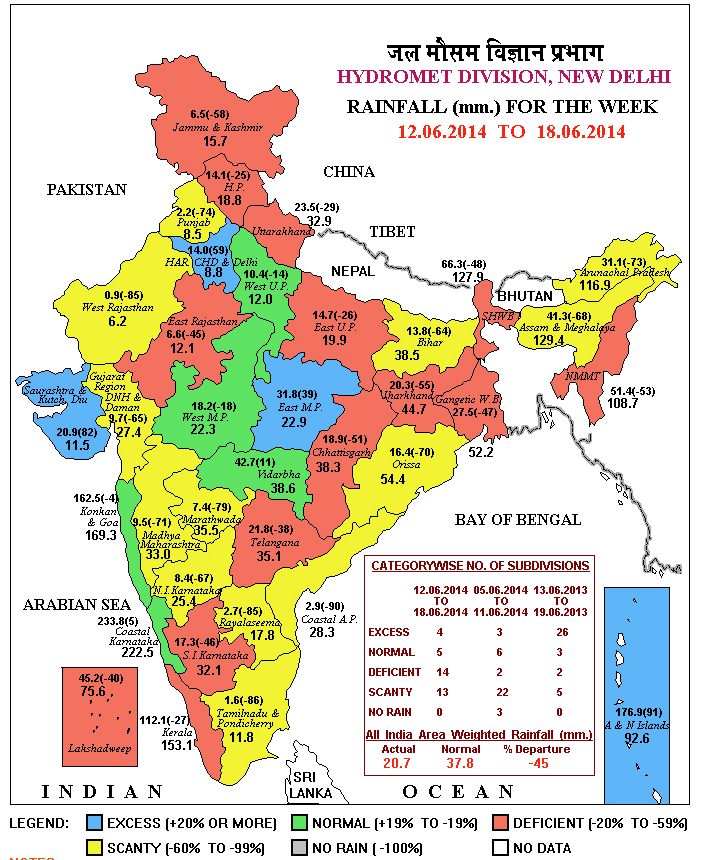
The typical IMD weekly rain map showing the colour codes and data for India's 36 meteorological subdivisions. This presentation urgently needs to be retired in favour of a more granular (district) map that is updated as soon as new data is received.

The typical IMD weekly rain map showing the colour codes and data for India’s 36 meteorological subdivisions. This presentation urgently needs to be retired in favour of a more granular (district) map that is updated as soon as new data is received.

A dense network of weather stations complemented by dedicated satellites provides continuous coverage of the sub-continent, the northern Asian land mass, the surrounding oceans southwards until beyond the Tropic of Capricorn. Methods to simply and accurately funnel this stream of real-time data and imagery are available, mostly at no cost, in order to aid local administrations, farmers and cultivators, and all citizens. It is this availability and relative simplicity of use (block-level weather forecasts for 72 hours are now available as local language apps on smartphones) that needs to be encouraged by the official agencies. More so in a year like 2014 with a late and weak monsoon and an El Nino threatening.

That is why IMD’s hoary top level categorisation of rainfall weekly quantities in the subdivisions must be replaced, both for what they describe and for how frequently they are described. These currently are: ‘normal’ in a subdivision is rainfall that is up to +19% above a given period’s average and down to -19% from that same average; likewise excess is +20% and more, deficient is -20% to -59% and scanty is -60% to -99%. The ‘normals’ are calculated based on the mean weekly rainfall for the period 1951-2000 with monitoring done in 641 districts distributed amongst the 36 meteorological subdivisions.

However, as all those who are engaged in studying and planning for the effects and impacts of climate change recognise, the changes observed on the ground over the last 15 years (rainfall, temperature, intensity of rain, duration of dry and wet spells) have made the term ‘normal’ difficult to use so that it continues to have meaning. Worse, a ‘normal’ with a wide range – over 28 percentage points from a given centre for a location – can lull local administrations particularly to misread the signs and ignore, on the basis of administrative expediency, the need to prepare for contingency.

By categorising rainfall ‘normals’ and departures from  ‘normal’ to become more administratively impelling – these proposed corrections also simplify the interpretations possible for rainfall above and below ‘normals’ – greater awareness and preparedness of administrations, key agencies and citizens to the deficiencies of monsoon can be fostered. For the district tables below therefore, I have re-cast the categories as follows (all based on the long-term average provided by IMD): Normal in a district is +5% to -5%; Deficient 1 is -6% to -20%; Deficient 2 is -21% and more; Excess 1 is +6% to +20%; Excess 2 is +21% and more.

Using these revised categories we see that for the second week (2014 June 12 to 18) of rainfall recorded in the districts (618 out of 641 reported) in 20 districts only was the rainfall ‘normal’ for that week. Under the existing IMD category of normal, this number is 81 – thus 61 district collectors will have been informed that in their district there is nothing to worry about, whereas the difference between a below normal reading of -5% and one of -15% can have a lasting impact particularly in rainfed districts where the social and institutional capacities to manage water and to plan credit needs for late sowing may be weak. In the same way, under the existing IMD categories, the difference between the conditions of two adjacent communities, one living in a district with a ‘deficient’ reading of -50% and the other in the neighbouring district (and in the same subdivision) with a ‘scanty’ reading of -70% is no more than technical, for the same degree of contingency planning will be required.

Whereas, for the same second rainfall week the IMD categories were ‘No Rain’ in 80 districts, ‘Scanty’ in 241 districts and ‘Deficient’ in 130 districts, under the proposed revision they will simply be ‘Deficient 2’ with 449 districts – thereby showing dramatically how widespread the conditions of the late and weak monsoon 2014 are – and ‘Deficient 1’ with 36 districts. State departments of agriculture, which have long worked on the frontlines of monsoon emergencies, whether drought or flood, have several generations of institutional experience to call upon in such circumstances. In most states, by 12 June alerts began to be issued to farmers and cultivators on measures to take if the monsoon is 15 days late, 30 days late and if signs of ‘terminal drought’ appear. Such preparedness must quickly extend to other areas – water resources, drinking water, food and civil supplies – for which a new meteorological literacy is urgently needed.

Filed Under: Monsoon 2014, Reports & Comment Tagged With: 2014, agriculture, climate, deficient, district, earth science, IMD, India, meteorology, monsoon, rainfed, satellite, scanty, weather station

  • « Previous Page
  • 1
  • 2
  • 3
  • Next Page »

Indiaclimate twitter

Tweets by @Indiaclimate

Notable

Between contemplation and climate

Whether or not the USA, Europe, the Western world, the industrialised Eastern world (China, Japan, South Korea, Taiwan), adhere to or not their paltry promises about being more responsible concerning the factors that lead to climate change, is of very little concern to us. We have never set any store by international agreements on climate […]

The ‘Hindu’, ignorant about weather and climate, but runs down IMD

We find objectionable the report by ‘The Hindu’ daily newspaper accusing the India Meteorological Department of scientific shortcoming (‘IMD gets its August forecast wrong’, 1 September 2016). The report claims that the IMD in June 2016 had forecast that rains for August would be more than usual but that the recorded rain was less than […]

dialogue

  • Misreading monsoon | Resources Research on Misreading monsoon
  • Satish on A tribute to the weathermen of Bharat
  • Climate portal editor on A tribute to the weathermen of Bharat
  • Climate portal editor on A tribute to the weathermen of Bharat
  • Climate portal editor on A tribute to the weathermen of Bharat

Categories

Copyright © 2026 indiaclimateportal.org.