The India Climate Observatory

Commentary, action and research on climate and development in India

  • Home
  • About
  • Monsoon 2018
  • Current
  • Bulletin
  • Contact
  • Announcements

Three views of monsoon 2018

May 14, 2018 by Climate portal editor Leave a Comment

The India Meteorological Department (IMD) on 16 April had issued its first long range forecast for the 2018 South-West Monsoon season, which the IMD has historically taken to be 1 June to 30 September. The IMD had said that the “monsoon seasonal rainfall is likely to be 97% of the Long Period Average with a model error of ± 5%”. The IMD had also said that its forecast “suggests maximum probability for normal monsoon rainfall (96%-104% of the long period average) and low probability for deficient rainfall during the season”.

In early June, the IMD will issue its second long range forecast for the 2018 monsoon. Until then, we have studied three of the more reliable (in our view) international multi-model ensemble forecasts for the monsoon. What are ensemble forecasts? Each consists of several separate forecasts (some ensembles use 50) forecasts made by the same computer model – these are run on super-computers such as the High Performance Computer System of the Ministry of Earth Sciences (one is at the Indian Institute of Tropical Meteorology in Pune with 4.0 petaflops capacity and the other at the National Centre for Medium Range Weather Forecasting in Noida with 2.8 petaflops capacity).

The MME forecast is based on estimated precipitation anomalies relative to the period 1993-2016, based on initial conditions calculated at the beginning of May 2018. Four blocks of three months each.

The separate forecasts that make up one ensemble are all activated from the same starting time. The starting conditions for each differ from each other to account as far as possible for the staggering number of climatological, atmospheric, terrestrial and oceanographic variables that affect and influence our monsoon. The differences between these ensemble members tend to grow as the forecast travels two, three, four and more months ahead of the present.

We have considered the ensemble forecasts for the 2018 monsoon of the Multi-Model Ensemble (MME) of the USA National Centers for Environmental Prediction, the NOAA Climate Prediction Center and the European Centre for Medium-Range Weather Forecast (ECMWF). In this order, we find that the MME is optimistic, the NOAA CPC is largely neutral and the ECMWF forecast is somewhat pessimistic. The forecasting periods are in blocks of three months.

Here are the details:

(1) The MME forecast, precipitation anomalies relative to the period 1993-2016, based on initial conditions calculated at the beginning of May 2018.
June July August (JJA) – west coast and Konkan, coastal Andhra Pradesh and Odisha, West Bengal, part of the North-East, the entire upper, middle and lower Gangetic region (Uttarakhand, Himachal, Uttar Pradesh, Bihar, Jharkhand), Madhya Pradesh, Chhattisgarh, Maharashtra and Telengana to have up to +1 mm/day. Rest of India other than Gujarat (-0.5 mm/day) normal.
July August September (JAS) – Gujarat to have up to -1 mm/day, Rajasthan up to -0.5 mm/day, Sikkim, Brahmaputra valley and Arunachal Pradesh up to -0.5 mm/day. Himachal Pradesh and Uttarakhand up to +0.5 mm/day, Madhya Pradesh, Odisha, Chhattisgarh, Jharkhand and West Bengal up to +0.5 mm/day. Andhra Pradesh and Tamil Nadu up to -0.5 mm/day.
August September October (ASO) – Gujarat up to -0.5 mm/day. Tamil Nadu up to -1 mm/day. Kerala and adjacent Karnataka up to -0.5 mm/day. Madhya Pradesh, Chhattisgarh, Odisha, West Bengal up to +1 mm/day. Tripura, Mizoram, Manipur, Nagaland, Uttarakhand, Himachal Pradesh up to +0.5 mm/day
September October November (SON) – Tamil Nadu, Kerala and adjacent Karnata up to -1 mm/day. Maharashtra, Madhya Pradesh, Chhattisgarh, Odisha, West Bengal, Himachal Pradesh and Uttarakhand up to +0.5 mm/day.
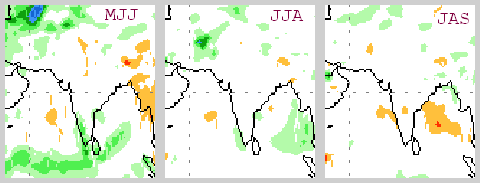
The NOAA CPC forecast is based on estimated seasonal precipitation anomalies using initial conditions of 30 April 2018 to 9 May 2018. Three blocks of three months each.

(2) The NOAA CPC forecast, seasonal precipitation anomalies using initial conditions of 30 April 2018 to 9 May 2018.
May June July (MJJ) – for most of India a normal reading (+0.5 to -0.5 mm/day fluctuation) and for the west coastal, Konkan, Kerala, south Tamil Nadu and coastal Andhra Pradesh areas variation of up to +1.5 mm/day.
June July August (JJA) – for most of India a normal reading (+0.5 to -0.5 mm/day fluctuation).
July August September (JAS) – normal for most of India. Some areas in the central Deccan plateau, on the west coast and east coast variation of up to -1 mm/day.

The ECMWF forecast is based on estimated mean precipitation anomaly based on climate period data of 1993-2016 and initial conditions as on 1 May 2018. Four blocks of three months each.

(3) The ECMWF forecast, mean precipitation anomaly based on climate period data of 1993-2016 and initial conditions as on 1 May 2018.
June July August (JJA) – all of the southern peninsula and part of the Deccan region (Kerala, Tamil Nadu, Karnataka, Andhra Pradesh, part of Telengana up to -100 mm for the period. West Bengal, Bihar, Jharkhand, Uttar Pradesh up to +100 mm for the period.
July August September (JAS) – all of the southern peninsula and the Deccan region – Kerala, Tamil Nadu, Karnataka, Andhra Pradesh, part of Telengana and Maharashtra up to -100 mm for the period.
August September October (ASO) – Maharashtra, Telegana, Andhra Pradesh and Karnataka up to -100 mm for the period.
September October November (SON) – Central and western India, eastern states and entire Gangetic region up to -50 mm for the period.

Rahul Goswami
Filed Under: Latest, Monsoon 2018 Tagged With: 2018, earth sciences, forecast, IMD, India, meteorology, monsoon

India becoming 1.4°C warmer until 2045

August 5, 2017 by Climate portal editor Leave a Comment

Launched in 2009 with the support of the Ministry of Earth Sciences (MoES), Government of India, the Centre of Climate Change Research (CCCR) is part of the Indian Institute of Tropical Meteorology (IITM) in Pune, Maharashtra. The CCCR focuses on development of new climate modelling capabilities in India and South Asia to address issues concerning the science of climate change.

The Centre has now released an ‘Interim Report on Climate Change over India’ which is intended to provide a brief overview of: (a) updated assessment of observed climate change over India, (b) future climate projections over India, (c) development of the IITM Earth System Model to better understand and quantify climate change and its regional impacts. The three topics, which are among the core research activities of the CCCR at IITM, have been presented as three chapters in this Interim Report, and an updated report is planned to be submitted later next year.

Assessments of impacts of climate change and future projections over the Indian region, have so far relied on a single regional climate model (RCM) such as the PRECIS RCM of the Hadley Centre, UK. While these assessments have provided inputs to various reports (INCCA 2010; NATCOMM2 2012), it is important to have an ensemble of climate projections drawn from multiple RCMs due to large uncertainties in regional-scale climate projections. Ensembles of multi-RCM projections driven under different perceivable socio-economic scenarios are required to capture the probable path of growth, and provide the behavior of future climate and impacts on various biophysical systems and economic sectors dependent on such systems. [The full report is available here (pdf).]

The Centre for Climate Change Research, Indian Institute of Tropical Meteorology (CCCR-IITM) has generated an ensemble of high resolution downscaled projections of regional climate and monsoon over South Asia until 2100 for the Intergovernmental Panel for Climate Change (IPCC) using a RCM (ICTP-RegCM4) at 50 km horizontal resolution, by driving the regional model with lateral and lower boundary conditions from multiple global atmosphere-ocean coupled models from the Coupled Model Intercomparison Project Phase 5 (CMIP5). The future projections are based on three Representation Concentration Pathway (RCP) scenarios (viz., RCP2.6, RCP4.5, RCP8.5) of the IPCC.

These high-resolution downscaled projections of regional climate over South Asia are generated as part of the International Programme called Coordinated Regional Downscaling Experiment (CORDEX) sponsored by the World Climate Research Programme. This chapter provides a synthesis of results from the CORDEX South Asia multi-RCM outputs, that allows us to interpret the strengths and limitations of future regional climate projections over India. This information is useful to reduce uncertainty of impact assessment estimates to an extent and provide a pan-Indian regional assessment for informed policy-making.

Key points

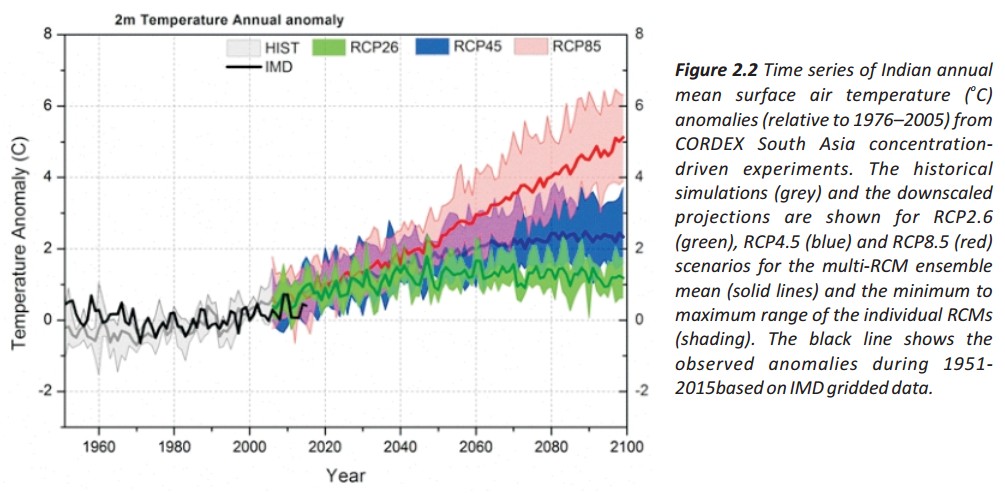
⊗ The all India mean surface air temperature change for the near-term period 2016–2045 relative to 1976–2005 is projected to be in the range of 1.08°C to 1.44°C, and is larger than the natural internal variability. This assessment is based on a reliability ensemble average (REA) estimate incorporating each RCM performance and convergence, and is associated with less than 16% uncertainty range.

⊗ The all India mean surface air temperature is projected to increase in the far future (2066–2095) by 1.35 ±   0.23°C under RCP2.6, 2.41 ± 0.40°C under RCP4.5 and 4.19 ± 0.46°C under RCP8.5 scenario respectively. These changes are relative to the period 1976–2005. The semi-arid north-west and north India will likely warm more rapidly than the all India mean.

⊗ Monthly increase in all India mean surface air temperature based on REA estimate is relatively higher during winter months than in the summer monsoon months throughout the 21st century under the three RCP scenarios.

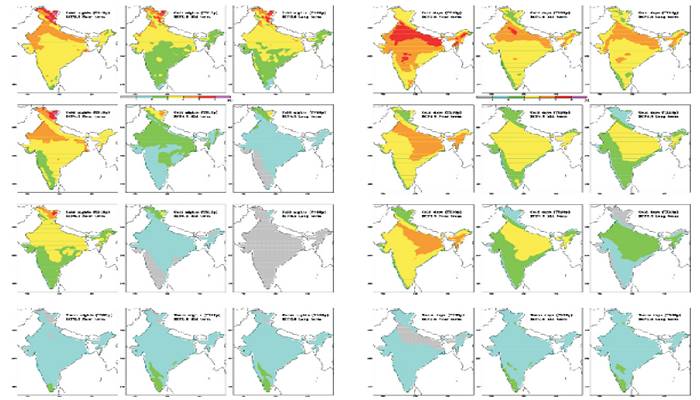
⊗ The REA changes for all India annual minimum temperature of 4.43 ± 0.34oC is more pronounced than that of 3.94 ± 0.45oC and 4.19 ± 0.46oC increases estimated for the respective annual maximum and mean temperatures respectively the end of the 21st century under RCP8.5 scenario. The models project substantial changes in temperature extremes over India by the end of the 21st century, with a likely overall decrease in the number of cold days and nights, and increase in the number of warm days and nights.

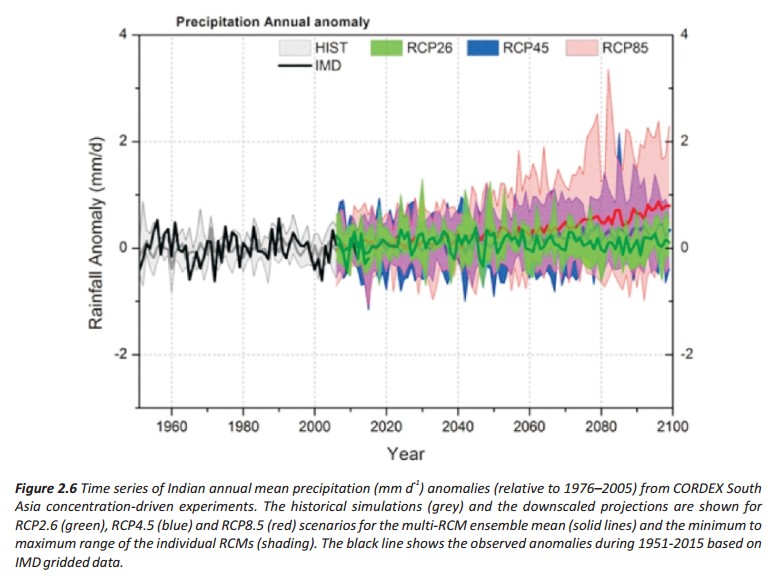
⊗ Although the all India annual precipitation is found to increase as temperature increases, the REA assessment indicates that precipitation changes throughout the 21st century remain highly uncertain.

⊗ The all India annual precipitation extremes are projected to increase with relatively higher uncertainty under RCP8.5 scenario by the end of the 21st century. The downscaled projections suggest that intensification of both dry and wet seasons is expected along the west coast of India and in the adjoining peninsular region.

The multi-RCM ensemble mean annual precipitation mid-term increase exceeds 10% over the west coast and the adjoining southern parts of the Indian peninsula for RCP4.5 scenario, while in the long-term the change for this mid-scenario exceeds 20% over the south-west coast and the adjoining Kerala state. The precipitation changes are not significant over the remaining parts of India for this mid-scenario up to the mid 21st century, however in long-term increase exceed 10% over north-west and adjoining parts of the country. The long-term projected annual precipitation increase exceeds 10% over most parts of India except in Jammu and Kashmir under RCP8.5 scenario, with relatively higher increase exceeding 30% projected along the west coast of India for this high-emission scenario by the end of 21st century.


Filed Under: Current Tagged With: Climate Change, earth sciences, earth system model, Hadley Centre, IITM, India, IPCC, MoES, precipitation, RCP, regional climate model, temperature, Tropical Meteorology

A monsoon in more than two halves

August 4, 2015 by Climate portal editor Leave a Comment

ICP_imd_forecast_20150804

Less rain for the remaining two months of the typical monsoon season of four months, but an overall season average that remains as it was forecast in June. This is the confusing monsoon update issued by the Earth System Science Organization (ESSO), the Ministry of Earth Sciences (MoES) and the India Meteorological Department (IMD).

There are aspects of IMD’s treatment of the monsoon season that need correction in our view. One is the long range forecast and its updates. Specific to this update, we are at the halfway stage of what is typically considered the four month monsoon (this too needs revision, as April and May rains were not the usual ‘unseasonal’ passing showers). However, any downward revision of the rainfall average for August and September ought to be an overall downward revision of the season, particularly as June-July have seen very uneven rain.

Consider the highlights of the updated monsoon forecast:

* Quantitatively, the rainfall over the country as a whole during the second half of the season (August to September) is likely to be 84% of LPA with a model error of ±8%.
* The rainfall during August is likely to be 90 ± 9% of LPA as was forecasted in June.
* The season (June to September) rainfall over the country as a whole is likely to be 88% of LPA with a model error of ±4% as was forecasted in June.

ICP_imd_points_20150804We make our criticism constructively, for a significant amount of the material India Climate Portal puts out through our website and our twitter account is taken from the public products released by IMD, ISRO and the Ministry of Earth Sciences, and we fully appreciate the quality of work and commitment of these agencies.

The national mean rainfall (“country as a whole”, as the IMD forecasts call it) must be abandoned as it does not represent the meteorological diversity of a very large country. Each of the 36 met sub-divisions is affected in different ways by the El Nino Southern Oscillation, the Indian Ocean dipole, the Madden-Julian Oscillation and other hemispheric phenomena.

There is no need for this simplification, which in fact achieves the opposite of timely accuracy.
The media in particular (television and radio, print, online) look for an overall message and, without guidance from authorities, picks up ‘top line’ messages that are of little or no use at the district and taluka level, and also for towns and cities. The question for IMD is rather: how will variability in monsoon together with the strengthening El Nino affect local outlooks for August to October. That is why we advocate monthly outlooks for the 36 met sub-divisions, to begin in May and to run until October (that is, half the year and not a third of the year), primarily to prepare local administrations for all possible scenarios.

There is no reason why this cannot be the approach. The Ministry of Earth Sciences coordinates the observation network (satellites included, and our agencies ISRO and NRSC are heavily involved), the IMD uses these data together with a very extensive network of weather stations all over India. The output is excellent quality and in the public domain. Because the meteorological services in India have historically been designed to aid and guide agriculture and cultivation, the agri-met bulletins, alerts and products are copious. Hence IMD/MoES listens to the needs of the agricultural departments and, more recently, disaster management agencies. Unfortunately, the interface with public is still minimal, which this central government can also easily remedy.

Filed Under: Latest, Monsoon 2015 Tagged With: 2015, climate, earth sciences, El Nino, forecast, IMD, India, ISRO, monsoon

Indiaclimate twitter

Tweets by @Indiaclimate

Notable

Between contemplation and climate

Whether or not the USA, Europe, the Western world, the industrialised Eastern world (China, Japan, South Korea, Taiwan), adhere to or not their paltry promises about being more responsible concerning the factors that lead to climate change, is of very little concern to us. We have never set any store by international agreements on climate […]

The ‘Hindu’, ignorant about weather and climate, but runs down IMD

We find objectionable the report by ‘The Hindu’ daily newspaper accusing the India Meteorological Department of scientific shortcoming (‘IMD gets its August forecast wrong’, 1 September 2016). The report claims that the IMD in June 2016 had forecast that rains for August would be more than usual but that the recorded rain was less than […]

dialogue

  • Misreading monsoon | Resources Research on Misreading monsoon
  • Satish on A tribute to the weathermen of Bharat
  • Climate portal editor on A tribute to the weathermen of Bharat
  • Climate portal editor on A tribute to the weathermen of Bharat
  • Climate portal editor on A tribute to the weathermen of Bharat

Categories

Copyright © 2025 indiaclimateportal.org.