The India Climate Observatory

Commentary, action and research on climate and development in India

  • Home
  • About
  • Monsoon 2018
  • Current
  • Bulletin
  • Contact
  • Announcements

The Pope confronts climate change

May 5, 2015 by Climate portal editor Leave a Comment

ICP_vatican_201505

The Vatican has put its considerable weight behind a very clear call for dealing sensibly and sensitively to climate change. The call has come from a summit organised and hosted by two of its own institutions, the Pontifical Academy of Sciences and the Pontifical Academy of Social Sciences. Both have as visiting or contributing academicians a panoply of academic heft – amongst them are Veerabhadran Ramanathan, professor of field atmospheric sciences, Krishnaswamy Kasturirangan, professor of astronomy, Mambillikalathil Govind Kumar (MGK) Menon, professor of physics, Chintamani N R Rao, professor of chemical science, and Govind Swarup, professor of astrophysics.

The summit was held on 28 April 2015 at the Vatican and was titled ‘Protect the Earth, Dignify Humanity: The Moral Dimensions of Climate Change and Sustainable Development’. The meeting was intended, said the Vatican’s press office, to help strengthen “the global consensus” on the issue of climate change. The 28 April meeting is part of the Vatican’s increasing efforts to influence the United Nations Climate Change Conference, which meets in Paris in December 2015 with the goal of getting countries to establish legally-binding protocols to protect the climate.

“Global climate change adversely affects every aspect of our civilisation and thus should be a matter of serious concern across all world religions,” said the Vatican statement on the meeting. “Their effect on the poor is even more severe. We wish to elevate the importance of the moral dimensions of protecting the environment in advance of the Papal encyclical and to build a global movement to deal with climate change and sustainable development throughout 2015 and beyond.”

Pope Francis is reported to have prepared a major encyclical – or moral guide for Catholics – which when released (probably in July) will stress the imperative of addressing human-caused global warming. In November 2013 Francis rocked the Catholic world with his apostolic exhortation in which he held forth convincingly on the economy of exclusion, the new idolatry of money, a financial system which rules rather than serves and the inequality which spawns violence.

This meeting ended with a joint statement on the moral and religious imperative of dealing with climate change in the context of sustainable development, and it is possible that the substantive points of the ‘Moral Dimensions’ meeting will find their way into the Pope’s encyclical on climate change and sustainable development (as it is likely to be popularly known as, shorn of the florid Latin).

With an opening address by Ban Ki-moon, the UN Secretary General, and with a statement by Jeffrey Sachs (economist and director of the UN Sustainable Development Solutions Network), the meeting included a panel on ‘Evidence on social exclusion and climate science’ with Peter Raven, Partha Dasgupta, John Schellnhuber, Martin Rees, V Ramanathan, Y.T. Lee and Paul Crutzen.

The point of view of the Vatican, and presumably of Pope Francis, was provided by Cardinal Peter K A Turkson (who in October 2014 said to the WTO that trade is “unbalanced and unjust when it adds to the landscape of social exclusion”). Explaining the subject Turkson said that “the current economic-developmental model is out of balance” and emphasised that “we must move away from this mode of behaviour, and instead become more protective”. Turkson said that we need innovative and sustainable technological and economic solutions, and “shift away from an unthinking infatuation with GDP and a single-minded zeal for accumulation”.

Pope Francis is turning a just idea of development and climate change into recurring themes of his papacy. He talked about these subjects during his inaugural mass in 2013, and told a crowd in Rome last May that mistreating the environment is a sin. Last year, the Vatican also held a five-day summit on sustainability, calling together microbiologists, economists, legal scholars, and other experts to discuss ways to address climate change. [Photo: Photographic Service L’Osservatore Romano]

– Rahul Goswami

Filed Under: Blogs Tagged With: Ban Ki-moon, Climate Change, CNR Rao, encyclical, Francis, Govind Swarup, Jeffrey Sachs, K Kasturirangan, MGK Menon, pontifical academy, Pope, sustainable development, Turkson, UN, V Ramanathan, Vatican

No American chop suey, thank you

November 13, 2014 by Climate portal editor Leave a Comment

Chinese President Xi Jinping and US President Barack Obama address a joint press conference following their talks at the Great Hall of the People in Beijing, China. Photo: Xinhua / Liu Weibing

Chinese President Xi Jinping and US President Barack Obama address a joint press conference following their talks at the Great Hall of the People in Beijing, China. Photo: Xinhua / Liu Weibing

Trade and manufacturing, geo-strategic ambitions and power jockeying, these are the objectives behind the so-called ‘deal’ between China and USA on ‘cutting’ carbon emissions and pollution. The ‘deal’ was announced at the conclusion of the 22nd Asia-Pacific Economic Cooperation (APEC) Economic Leaders’ Summit, held in Beijing, China, and therefore partly reflected the agendas of Asian trade within the region and with the USA.

The ‘deal’ on climate between President of China Xi Jinping and US President Barack Obama indicates in the first place the internal compulsions faced by the governing leaderships that they represent in both countries. This balancing however is commonplace at economic and trade summits, where new agreements and pacts are presented as being good for the international order, but whose details reveal the truth. [Read the special India Climate Watch bulletin here.]

So it is with the Xi-Obama ‘deal’ on climate change and emissions, but with added aspects that are disturbing for the shape that the post-Kyoto framework on climate action is taking. According to media reports (mainly from the USA), representatives of the two governments have been negotiating for several months so that this ‘deal’ could be announced now.

If true, this tells us that equality of representation at international climate negotiations, and that a multi-lateral approach itself, are being ignored by the world’s biggest polluting country (China) and the world’s biggest economy (the USA, measured in current US dollars only). In preparing for such a ‘deal’ therefore, the political leaderships of both countries have signalled that their international responsibilities towards climate justice matter less than bolstering a trading system which rests on globalised production, deployment of capital and homogenous consumption.

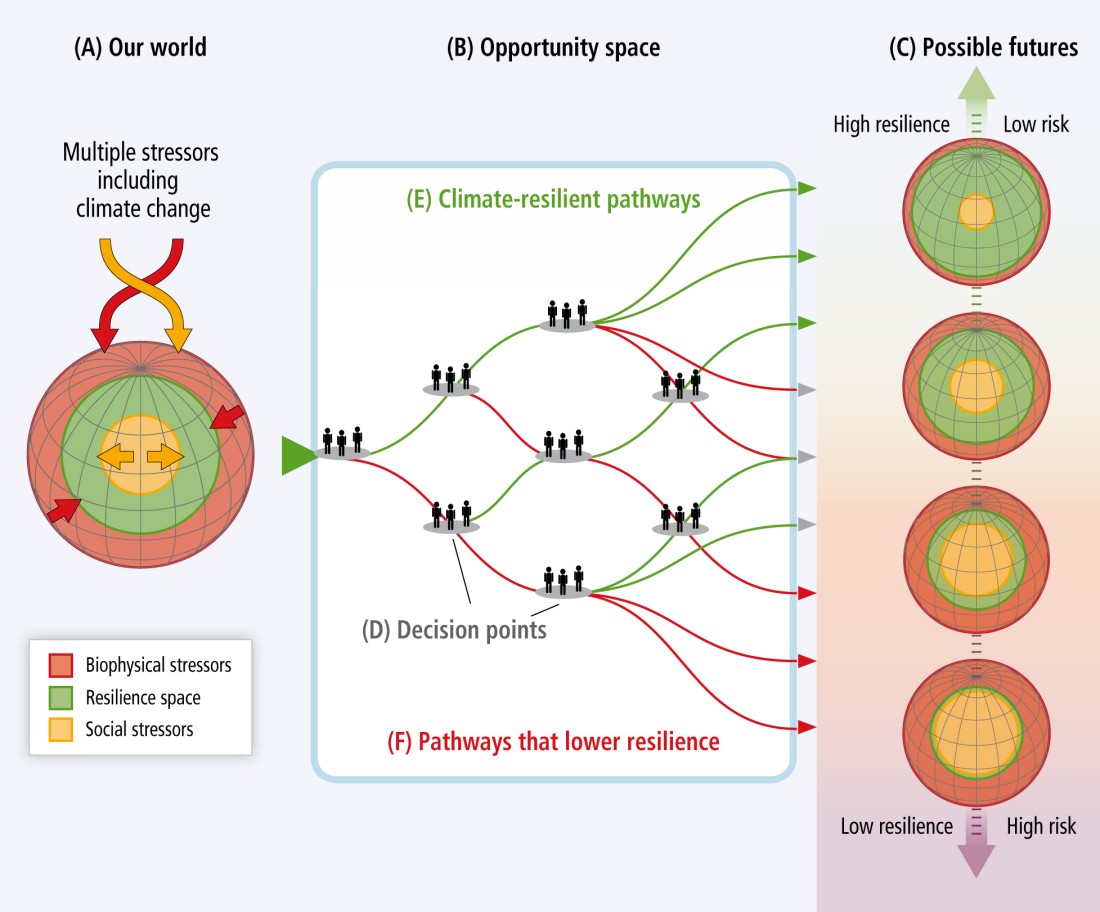
The IPCC's advice on reaching resilience during an era of changing climate. Quite ignored by the leadership of the two biggest polluting countries. Image: IPCC

The IPCC’s advice on reaching resilience during an era of changing climate. Quite ignored by the leadership of the two biggest polluting countries. Image: IPCC

The Secretary-General of the United Nations, Ban Ki-Moon, issued a statement welcoming this ‘deal’. In it Ban has welcomed “the joint announcement” by the two leaders “of their post-2020 action on climate change, as an important contribution to the new climate agreement to be reached in Paris next year”. The UN must perforce look for some positive element in any such ‘deal’, but calling it an important contribution to COP 21 (conference of parties) to be held in Paris in 2015 is misleading.

Ban’s own statement has mentioned the need for “a meaningful, universal agreement in 2015” however the Beijing announcement signals that the opposite will ensue – economic and trading blocs will continue to advance their separate agendas and so subordain the responses required to climate change.

Ban has also welcomed “the commitment expressed by both leaders to increase their level of ambition over time as well as the framing of their actions in recognition of the goal of keeping global temperature rise to below 2 degrees Celsius”.

This too is not so. The Emissions Database for Global Atmospheric Research (maintained by the European Commission’s Joint Research Centre) has said that the required reduction in the increase in global CO2 emissions can be achieved provided: (a) China achieves its own target of a maximum level of energy consumption by 2015 and its shift to gas with a natural gas share of 10% by 2020; (b) the USA continues a shift its energy mix towards more gas and renewable energy; and (c) European Union member states agree on restoring the effectiveness of the EU Emissions Trading System to further reduce actual emissions. The actions thus outlined for the USA and China will under the new ‘deal’ either not take place or be loosely and ineffectually interpreted.

The view of China’s political establishment is visible in the treatment of the climate ‘deal’ by its official media. In its commentary on the Xi-Obama meeting, Xinhua, the state news agency, explained that President Xi Jinping “outlined six priorities in building a new type of major-country relationship with the United States”. The language and manner indicate that what is being presented in the media as a ‘landmark deal’ between the two countries on climate change is in fact part of a continuing re-negotiation of the roles of both countries in today’s world.

Special bulletin of the India Climate Watch on the China-USA climate 'deal'.

Special bulletin of the India Climate Watch on the China-USA climate ‘deal’.

The six priorities (this label follows the typical political construction of policy China – for years the ‘three represents’ of the Chinese Communist Party had guided state thinking) are: communication between high-level officials, mutual respect, cooperation in all aspects, management of disputes, collaboration in the Asia-Pacific and joint actions on global challenges. The response to climate change is part of the sixth priority, joint actions on global challenges (which also includes counter-terrorism and epidemic control). In its official statement on the ‘deal’, China has pointed out that in 2013 bilateral trade between the USA and the People’s Republic soared to US$ 520 billion while two-way investment stood at US$ 100 billion. This volume and flow is what will be protected to the extents possible by both governments.

The staged euphoria over this ‘deal’ does not obscure its non-binding nature. According to commentary from the People’s Republic, 2030 would be set as the peak year for its soaring greenhouse gas emissions, while the USA said it would cut emissions by more than a quarter from 2005 levels by 2025.

Data from the International Energy Agency show that for the USA, total final oil products consumption in 2012 was 717 million tons of oil equivalent (mtoe; in 2007 the quantity was 829 mtoe) while the totals for all energy sources were 1,432 mtoe in 2012 which was a reduction from 1,572 mtoe in 2007). In China, total final oil products consumption in 2012 was 421 mtoe (in 2007 it was 308 mtoe) while the use of coal continued to rise – 558 mtoe in 2012 whereas it was 480 mtoe in 2007. In China the totals for all energy sources was 1,703 mtoe in 2012 which is 28% above what it was (1,326 mtoe) five years earlier.

A rapid analysis carried out by the Centre for Science and Environment (CSE) indicates that: (1) greenhouse gas (GHG) emissions of the USA in 2025 will be 5 billion tons of carbon dioxide equivalent; from 1990 levels, the USA will reduce its emissions by just 15-17% by 2025; to meet the 2C target, US emissions should be at least 50-60% per cent below 1990 levels considering its historical responsibility of causing climate change, and (2) China’s emissions will peak at 17-20 billion tons of carbon dioxide equivalent by 2030 and its per capita emissions in 2030 will be 12-13 tons; these are not in line with the 2C emissions pathways put forth by the Intergovernmental Panel on Climate Change (IPCC).

The IPCC has, less than a fortnight ago, presented the need for what it bluntly calls “zero net emissions” by 2100 – and that means changing economies and trade and the trend of globalisation now – to avert the worst. But the head of the IPCC, Rajendra Pachauri, has called the China-US climate ‘deal’ “a heartening development, a good beginning and I hope the global community follows this lead and maybe builds on it”. This is certainly not the lead to follow, for it ignores the IPCC’s stark warning, and instead signals that global and regional powers can bully their way to gaining sanction for furthering their short-term economic agendas even while climate science demands that they do otherwise.

– Rahul Goswami

Filed Under: Current, Reports & Comment Tagged With: APEC, Ban Ki-moon, Barack Obama, Beijing, China, Climate Change, COP, economy, emissions, energy, fossil fuel, IPCC, Kyoto Protocol, trade, UN, USA, Washington, Xi Jinping

We need more than summits and marches to deal with climate change

September 22, 2014 by Climate portal editor Leave a Comment

Ban Ki-moon with marchers. "There is no 'Plan B' because we do not have 'Planet B'." Photo: UN Photo / Mark Garten

Who is the man in the blue cap and why is he on the street? Ban Ki-moon with marchers. “There is no ‘Plan B’ because we do not have ‘Planet B’.” Photo: UN Photo / Mark Garten

On September 20 and 21, the gathering of what has been called ‘climate marchers’, including many youth, expresses a growing popular concern over the impact of global warming on the world’s environment. During the march in New York, USA, the largest of the several marches held in several cities and countries, the secretary general of the United Nations, Ban Ki-moon, joined the marchers. On 23 September, the Climate Summit he has called is expected to draw more than 120 heads of government to, as the UN puts it, “galvanise action on climate change”.

Ban said he hoped the peoples’ voices will be “truly reflected to the leaders” when they meet. “Climate change is a defining issue of our time,” he added. “There is no time to lose. If we do not take action now we will have to pay much more.” There is widespread expectation that government delegations to the summit will have “concrete initiatives and that it will provide significant momentum for a global agreement on tackling climate change”.

All this has likely been of interest to the youth, but the expectation of a new push towards a global agreement on dealing with climate change needs to be balanced by even the most cursory examination of the last 20 years of climate negotiations, under the auspices of the UN Framework Convention on Climate Change (the UNFCCC), and particularly the last four years of an ever larger number of meetings all of which have singly and together contributed nothing to any hoped-for global agreement.

Nonetheless, climate change continues, the science gathers experience and the evidence accumulates. Moreover, it has become clear that a climate treaty (if and when it is signed) will not be about a single issue. Climate change is one amongst an inter-connected web of subjects related to development, sustainability, habitats and settlements, equity and justice, trade, public and social institutions, technology, investments and finance, innovation and national priorities. In many ways, the responses to climate change are directly influenced by thinking and practice in all these areas.

In a short new collection of working ideas, ‘The Way Forward in International Climate Policy: Key Issues and New Ideas 2014’, published and distributed by the Climate and Development Knowledge Network, the thesis that is advanced is: “research suggests that economic and ecological aims can co-exist, and even reinforce each other”. This may be partly true but is also contestable. As the CDKN collection also has pointed out, political tensions persist between economic growth and development on the one hand (but these should more correctly be called business and industry interests), and environmental sustainability on the other.

The term ‘sustainable development’ has engaged policy-makers and academics for 40 years now, and remains central to a set of goals (and large numbers of ‘targets’ and indicators) which will be finalised by the UN this year. Much more swiftly, ‘green growth’ has come forward as a competing idea, because ‘growth’ sounds more powerful to industry and investors, whereas ‘sustainability’ seems to imply conservation and status quo.

Historical contributions to greenhouse gases and the socio-political Southern view.

Historical contributions to greenhouse gases and the socio-political Southern view.

The marchers in New York may harbour some ideas about fairness, equity and the ethical issues surrounding climate change and those it affects. These concepts have indeed been highlighted by the IPCC climate change mitigation and adaptation reports. Although necessary, these concepts may be interpreted and implemented within the framework of national priorities and goals, yet the connections – between the concepts around equity, between what happens on the ground, and between the thickets of negotiating text – must be made.

Fairness between countries also underlies the idea of ‘common but differentiated responsibilities’ which many of the so-called ‘developing’ and the so-called ‘less developed’ countries invoke during climate negotiations. It is a concept seen as being one of the key principles of the UNFCCC and a central element of fairness and equity discussions. But it has lead to intractable arguments that pit South versus North. Who should bear the burden of investments towards adaptation and mitigation and who should benefit? Without internationally agreed climate action costs continue to mount: how should these be dealt with? Unfortunately, these questions are debated in the UN and at international negotiations not by those affected but by the financial institutions and their technology providers.

The 23 September UN Climate Summit has already focused on public spectacle and visual stylistics in the days before the meeting, rather than outline the substantial and very delayed points of discussion. The UN headquarters has been lit up with what is described as “a spectacular 30-storey architectural projection show aimed to inspire global citizens to take climate action” which is to provide a “visual reminder of what is at stake”. This is wasteful and distracting – those who have been affected by climate change in its many forms have no need to be reminded by expensive spectacle half a world away.

That is why, 22 years after countries joined the UNFCCC, there remains a clear contrast between the urgency of the situation and the absence of any significant response from the political establishment. The urgency is:

(1) The hottest March-May period in the global record which has pushed numerous record spikes in the global measures this summer. By August, according to NASA, the global average had again climbed to new high levels. NASA showed that the Global Land-Ocean Surface Temperature Index had climbed to 0.70 degrees Celsius above the mid 20th century average and about 0.95 degrees Celsius above the 1880s average. The previous record high for the period was set in 2011 at 0.69 degrees C above the global 1951 to 1980 average.

(2) For the first time, monthly concentrations of carbon dioxide (CO2) in the atmosphere topped 400 parts per million (ppm) in April 2014 throughout the northern hemisphere. “This threshold is of symbolic and scientific significance and reinforces evidence that the burning of fossil fuels and other human activities are responsible for the continuing increase in heat-trapping greenhouse gases warming our planet.” All the northern hemisphere monitoring stations forming the World Meteorological Organisation (WMO) Global Atmosphere Watch network reported record atmospheric CO2 concentrations during the seasonal maximum. This occurs early in the northern hemisphere spring before vegetation growth absorbs CO2.

The contrast between urgency and the response of the world’s political leaders has occurred, in large part, due to the contradiction which climate negotiations carefully steer around – it is not possible to resolve climate change and other major environmental problems within the framework of a macro-economic system based on GDP growth and monetary expansion. For this reason, the perspective on which the People’s Climate March was organised offers no way forward and will contribute little to a lasting and fair climate treaty.

Five months ago the secretary general of the World Meteorlogical Organisation warned that “time is running out” when the 400 ppm was crossed. “This should serve as yet another wakeup call about the constantly rising levels of greenhouse gases which are driving climate change. If we are to preserve our planet for future generations, we need urgent action to curb new emissions of these heat trapping gases.” he said. Growth and consumption – green or sustainable or otherwise – is not the answer. And a recognition of that essential condition must be the starting point at the UN Climate Summit on 23 September 2014.

– Rahul Goswami

Filed Under: Current, Reports & Comment Tagged With: 2014, 400 ppm, Ban Ki-moon, Climate Change, climate summit, development, global warming, IPCC, meteorological, NASA, surface temperature, sustainable, UN, UNFCCC, United Nations, WMO

Indiaclimate twitter

Tweets by @Indiaclimate

Notable

Between contemplation and climate

Whether or not the USA, Europe, the Western world, the industrialised Eastern world (China, Japan, South Korea, Taiwan), adhere to or not their paltry promises about being more responsible concerning the factors that lead to climate change, is of very little concern to us. We have never set any store by international agreements on climate […]

The ‘Hindu’, ignorant about weather and climate, but runs down IMD

We find objectionable the report by ‘The Hindu’ daily newspaper accusing the India Meteorological Department of scientific shortcoming (‘IMD gets its August forecast wrong’, 1 September 2016). The report claims that the IMD in June 2016 had forecast that rains for August would be more than usual but that the recorded rain was less than […]

dialogue

  • Misreading monsoon | Resources Research on Misreading monsoon
  • Satish on A tribute to the weathermen of Bharat
  • Climate portal editor on A tribute to the weathermen of Bharat
  • Climate portal editor on A tribute to the weathermen of Bharat
  • Climate portal editor on A tribute to the weathermen of Bharat

Categories

Copyright © 2025 indiaclimateportal.org.