The India Climate Observatory

Commentary, action and research on climate and development in India

  • Home
  • About
  • Monsoon 2018
  • Current
  • Bulletin
  • Contact
  • Announcements

The slowing motion of India’s quick mobility

March 21, 2015 by Climate portal editor Leave a Comment

RG_ICP_vehicles_households_20_years

This is a chart whose lines drift downwards as time goes by, quite the opposite of all the usual depictions of India’s rising GDP, rising income, rising purchasing power, and so on. But in the two dropping lines is the proof that India’s households are tying themselves up in stifling vehicular knots.

This chart shows what we call two-wheelers (scooters and motor-cycles) and cars (four-wheeled passenger vehicles, formally). It also shows number of households and a span of 20 years. The two lines show the number of households to a car (the orange line) and the number of households to a two-wheeler (the blue line). As there are many more two-wheelers than there are cars, they are on different scales, so the left axis is for the two-wheelers and the right for cars.

vehicles_2012I have taken the data from two sources. One is the Census of India, for the census years 2011, 2001 and 1991. The other is the Road Transport Yearbook (2011-12) issued by the Transport Research Wing, Ministry Of Road Transport and Highways, Government Of India. The yearbook includes a table with the total number of registered vehicles (in different categories of vehicle – two-wheelers, cars, buses, goods vehicles, others) for every year. The number of households is from the census years, with simple decadal growth applied annually between census years. I have not yet found the detailed data that will let me refine this finding between urban and rural populations.

This is what the chart says: in 1992, there were 10 households to a two-wheeler and 48.7 households to a car. Ten years later in 2002 there were 4.8 households to a two-wheeler and 26.2 households to a car. Another ten years later in 2012 there were 2.2 households to a two-wheeler and 11.8 households to a car.

vehicles_2005The implications are several and almost all of them are an alarm signal. Especially for urban areas – where most of the buying of vehicles for households has taken place – the physical space available for the movement of people and goods has increased only marginally, but the number of motorised contrivances (cars, motor-cycles, scooters and more recently stupidly large SUVs and stupidly large and expensive luxury cars) has increased quickly. Naturally this ‘growth’ of wheeled metal has choked our city wards.

But there are other implications. One is the very idea of individual mobility in and through a town or city. The connection – foolishly maintained by one government after another, and foolishly defended by macro-economists and industrial planners – between the automobile industry and gross domestic product (GDP) has crippled common sense.

vehicles_1995More motorised conveyance per household also means more fuel demanded per household, and more fuel (and money) wasted because households are taught (by the auto industry with the encouragement of the foolish cohorts I mentioned earlier) that they are entitled to wasteful personal mobility. Over 20 years, the number of cars per household has increased 4.1 times but the number of buses per household has increased only 2.8 times. That is embarrassing proof of our un-ecological and climate unfriendly new habits.

In 2012, there were 1.67 million buses (of all kinds and configurations), there were 7.65 million goods vehicles (to move all those appliances demanded by households, food crops, fertiliser, retail food, etc), 13.16 million other vehicles (which as the ministry says “include tractors trailers, three-wheelers (passenger vehicles)/LMV and other miscellaneous vehicles which are not classified separately”), 21.56 million cars (including jeeps and taxis), and 115.41 million two-wheelers. There are far too many of some kinds and not enough of others. More than 20 years after ‘liberalisation’ began, India’s household mobility is crawling along in first gear for having made too many wrong choices.

– Rahul Goswami

Filed Under: Blogs, Latest Tagged With: automobiles, cars, commuter, economy, energy, fuel, GDP, India, motorcycle, road transport, scooter, two-wheelers, urban mobility, vehicles

Climate, Bharat and junk food

January 28, 2015 by Climate portal editor Leave a Comment

RG_ICP_20150128

We are being misinformed and poorly entertained. There is a great big complex apparatus that tells us, as it has done for most of the last 20 years, that climate change is about science and observation, about technology and finance. This is the international apparatus. Then there is the national bedlam, comprising government, NGOs, think-tanks, research institutes and academia, industry and business, capital markets and finance. The national bedlam on climate change contains many views, some of which are directly related to the international apparatus. Our government, usually in the form of utterances by the Ministry of Environment, Forests and Climate Change, attempts to connect economics to everything else it thinks is important, and present the resulting mess as our climate change policy, which only provokes more bedlam.

Such is the state of affairs in India concerning climate change. Industry and finance, whatever their motivations (profit, market, subsidies, friendly politicians, and so on), are fairly consistent in what they say they want. NGOs and think-tanks – most of which function as localised versions of the international apparatus – are responsible for an outsized share of the bedlam, for they must not only protect the interests of their principals (usually in the West) but at the same time be seen to be informed, authoritative and influential at home. Ordinarily, this renders them schizophrenic, but the hullabaloo surrounding climate change in India is so loud, no-one notices the schizophrenia of the NGOs and think-tanks. Media – that is to say, vapid but noisy television and dull but verbose print commentators – sides with one group or another depending on who’s paying for the junkets.

The punctuations in this long-running and episodic climate change opera that we witness in India are the annual international gatherings, and the erratic policy pronouncements by the central government. For most people, struggling with food price inflation, with urban living environments choked by particulate matter, hounded by creditors and surrounded by useless gadgetry, climate change is a non-subject. And so the middle class stays out of the bedlam, for it is too busy negotiating the storied ‘growth’ of India or breathlessly seeking to profit from it in as many ways as there are flavours of potato chips. Who is left from the 1.275 billion Bharat-vaasis who can cast an appraising eye on the bit players and techno-buskers, and who can judge for themselves the consequences of their actions? We don’t know. And it is such not knowing that balances, with a taut silence, the bedlam of the posturing think-tanks, the technology fetishists, the grasping NGOs, the carbon merchants and their political cronies.

It has helped us not at all to be served, every other week or so, the bland intellectual regurgitations of India’s talking climate heads. It has helped us not at all to be preached at (faithfully reported, accompanied by appropriate editorial cant) by the United Nations whose agency, the UNFCCC, has fostered 20 years of expensive gatherings designed to deceive thinking folk. It has helped us not at all to have to correct, time and again, a government that does nothing about capitalism’s operatives who consistently attack and dismantle efforts to protect our people from environmentally destructive activities. It has helped us not at all to have dealt out to us, from one ruling coalition to the next, from a fattened ‘empowered group of ministers’ to a PM’s Council that prefers fiat, missions and programmes that speak ‘renewable’ but which refuse stubbornly to talk consumption.

Climate change and Bharat is about none of this and it is about all of this in relation to our behaviour. Ours is the land of air-conditioned youth devouring cup noodles while gesturing with greasy fingers across smartphone screens. It is not the land where their grand-parents tilled fields, tended orchards, walked on pilgrimages and lit lanterns in simple dwellings. But this is now, and here, in urban Coimbatore and Cuttack as much as in rural Darbhanga and Dharwad, the reckoning of the effect of our 1.275 on climate has to do with the buying of cars (bigger and two per family) and the widening of roads.

It has to do with the building of housing ‘complexes’ (modern amenities and 24×7 power, but naturally), the contrived convenience factor of retail food markets whose demands deepen the monoculturing of our land mosaics, once so very diverse with coarse cereals, the myth-making of jobs and employment by cramming vast buildings with directionless migrant youth, and attaching to them (costs calculated by the second) the electronic machinery that makes online retail possible, the imagery of the flick of the switch or click of a button delivering goods and services as though from the horn of plenty, the vacuous promises of imminent superpowerdom and a techno-utopia set to the beat of Bollywood lyrics. We have indeed been misinformed.

– Rahul Goswami

Filed Under: Blogs Tagged With: automobiles, Climate Change, consumption, economy, electronics, employment, environment, GDP, India, jobs, migration, online retail, policy, technology, UNFCCC, youth

India’s giant megawatt trap

September 10, 2014 by Climate portal editor 1 Comment

A panel of charts that show India's energy consumption, imports, and dependence on fossil fuel.

A panel of charts that show India’s energy consumption, imports, and dependence on fossil fuel.

Electricity as fundamental right and energy convenience as the basis of ‘development’ in Bharat and in India. If this is what Piyush Goyal means when he says his government is “is committed to ensure affordable 24×7 power” then it will come as yet another commitment that supports energy provision and consumption as the basis for determining the well-being of Bharat-vaasis and Indians (the UPA’s Bharat Nirman was the predecessor). But the Minister of State (Independent Charge) for Power, Coal and New and Renewable Energy cannot, using such a promise, ignore the very serious questions about the kind of ‘development’ being pursued by the NDA-BJP government and its environmental and social ramifications.

Goyal has said, via press conferences and meetings with the media, that the NDA government is committed to ensuring affordable power at all times (’24 x 7′ is the expression he used, which must be banished from use as being a violent idea – like nature our lives follow cycles of work and rest and ’24 x 7′ violently destroys that cycle). Goyal has promised, pending the taking of a series of steps his ministry has outlined, that such a round the clock provision of electric power will be extended to “all homes, industrial and commercial establishments” and that there will be “adequate power for farms within five years”.

The summary of India's power generation capacity, by type and by region. Source for data: Central Electricity Authority

The summary of India’s power generation capacity, by type and by region. Source for data: Central Electricity Authority

Some of the very serious questions we raise immediately pertain to what Goyal – with the help of senior ministry officials and advisers – has said. The NDA-BJP government will spend Rs 75,600 crore to (1) supply electricity through separate feeders for agricultural and rural domestic consumption, said Goyal, which will be used to provide round the clock power to rural households; and (2) on an “integrated power development initiative” which involves strengthening sub-transmission and distribution systems in urban areas. This is part of the “transformative change” the ministry has assured us is for the better. Goyal and his officials see as a sign of positive transformation that coal-based electricity generation from June to August 2014 grew by nearly 21 per cent (compared with the same months in 2013), that coal production is 9% higher in August 2014 compared with August 2013, and that Coal India (the largest coal producer company in the world which digs out 8 of every 10 tons of coal mined in India) is going to buy 250 more goods rakes (they will cost Rs 5,000 crore) so that more coal can be moved to our coal-burning power plants.

UN_Climate_Summit_2014_smWe must question the profligacy that the Goyal team is advancing in the name of round the clock, reliable and affordable electricity to all. To do so is akin to electoral promises that are populist in nature – and which appeal to the desire in rural and urban residents alike for better living conditions – and which are entirely blind to the environmental, health, financial and behavioural aspects attached to going ahead with such actions. In less than a fortnight, prime minister Narendra Modi (accompanied by a few others) will attend the United Nations Climate Summit 2014. Whether or not this summit, like many before it, forces governments to stop talking and instead act at home on tackling anthropogenic climate change is not the point. What is of concern to us is what India’s representatives will say about their commitment to reduce the cumulative impact of India’s ‘development’, with climate change being a part of that commitment.
At the UN Climate Summit 2014, it will be heard (in as many languages as there are translators available for them) that energy demand is growing along with expanding global wealth (but the UN will not say how unequally that extra wealth has been distributed). There will be grave references made to growing populations with a large number still without the round the clock electricity that Goyal has promised. Many speakers (eminent experts, as the UN system calls them) will be mobilised to remind the gathering that a shift toward renewable sources of energy (such as solar, wind and geothermal) is needed, that greater energy efficiency in appliances, buildings, lighting and vehicles are needed, and that this is so because it is essential to use the world’s resources sustainably, to diversify economies and successfully address the challenge of climate changes. It will sound suitably solemn and uplifting at the UN headquarters in New York, but the story at home in Bharat and India is solemn and deeply worrisome.

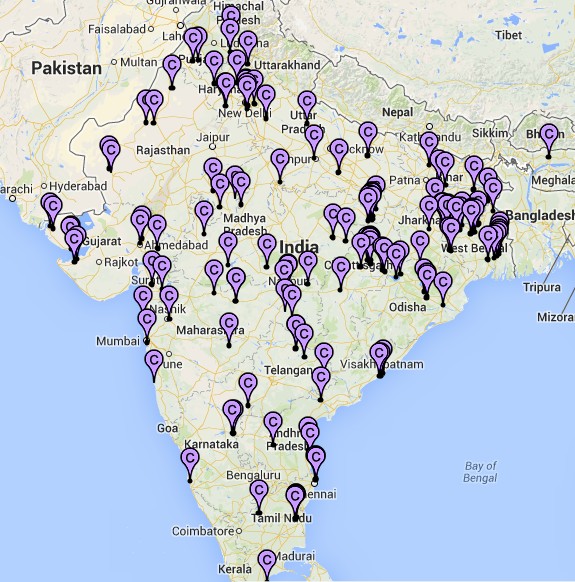
Where India's coal-burning power plants are. Map courtesy Global Energy Observatory.

Where India’s coal-burning power plants are. Map courtesy Global Energy Observatory.

Some of the tale is of very short-term inconvenience, such as when Mumbai went without electricity for a few hours on 02 September. The business and financial media reported that “back-up generators at banks and brokerages ensured that financial business was largely unaffected” and then circulated the familiar complain that India does not generate enough electricity to meet rapidly rising demand, that a severe shortage of coal (half our 150-odd coal burning plants are reported as having no more than a week’s supply of coal) has raised fears of more widespread blackouts.

Dire tweets from a leading industrialist, Anand Mahindra, were also reported: “Dark office in Mumbai. Lights out in the whole area. The coal crisis is beginning to literally show its dark side. A threat to the India story.” This senior member of the clutch of companies on the Bombay Stock Exchange ‘A’ List underlining a threat to the ‘India story’ led the business and financial media to quickly exert psychological duress on the NDA-BJP – “any grid collapse would cast doubt on the crisis management skills of the new government led by Prime Minister Narendra Modi”.

Electricity as fundamental right and energy convenience is moreover essential in the view of Indian industry to reaching the 8% per year GDP growth threshold, which this section appears to consider the single goal of the Republic of India. Hence where energy and the generation and provision of electricity is concerned, Goyal and his team have listed eight steps their ministry will undertake: (1) to rationalise coal supplies (by which is meant, as far as I can make out, move coal fewer kilometres to nearer power plants instead of distant ones); (2) create a statutory coal regulator; (3) civil nuclear cooperation agreement (Australia mentioned for uranium); (4) surveillance at major coal mines to control coal theft; (5) hydro-electric power generation in Jammu and Kashmir (“fast track” they say); (6) environmental clearances (“government will speed up environment and forest clearances to projects”); (7) bring more generation capacity at gas-based power online; (8) clear the solar ultra mega power plant at Sambhar near Jaipur, Rajasthan (the area is a site for migratory birds and an ecological refuge).

Had we an environment regulatory system and a project appraisal and clearances mechanism that protected environment, biodiversity, natural resources and our natural heritage, points 3, 5, 6 and 8 could under no circumstance have appeared on the Ministry of Power list. But the NDA-BJP government has in its first three months taken swift steps to eases clearances for industrial and infrastructure projects. Goyal’s colleague in the cabinet, Prakash Javadekar (minister of state for environment, forests and climate change), has worked to get the MoEF&CC to loosen the norms for expansion of coal mining projects producing up to 8 million tonnes of coal a year, and to adopt a ‘cluster approach’ in clearing smaller mines in the coal-rich belts of India. The environment ministry is also – as the Rajya Sabha was told – “streamlining environmental clearance process by delegating more powers to the State level Environment Impact Assessment Authorities (SEIAAs) for granting” such clearances, and neither house of Parliament has inquired critically as to whether the states so favoured have in place the evaluating expertise and capacities of sufficient authority and independence to not clear those projects which will harm environment, biodiversity, natural resources and our natural heritage.

Poor ambient air quality in our cities is hazardous to health, and emissions from coal-burning power plants are an important contributor to urban air pollution. This chart of a New Delhi region is courtesy Asia Air Pollution Real-time Air Quality Index (AQI).

Poor ambient air quality in our cities is hazardous to health, and emissions from coal-burning power plants are an important contributor to urban air pollution. This chart of a New Delhi region is courtesy Asia Air Pollution Real-time Air Quality Index (AQI).

While industry and a growing urban middle class expect ‘development’ and convenience, represented mainly by uninterruptible kilowatts, and exert a disproportionate amount of pressure on the state to fulfil these desires, there is a short list of steps very different from Goyal’s which must be recognised by the NDA-BJP government and state governments. This is:

(1) There is 172,986 MW of thermal power capacity (149,178 coal, 22,608 gas and 1,200 diesel), 40,798 MW of hydro-electric, 31,692 MW of renewables and 4,780 MW of nuclear, for a total of 250,257 MW. That’s on paper, whereas the actual power generation every average day (in 2014, according to the Central Electricity Authority, which is the apex power sector planning body) has been around 135,000 MW. From every power plant to every grid and to every distribution network, the aggregate transmission and commercial losses are estimated to be 26%. Judging from the trend of 2000 onwards, India’s coal consumption would have been 710 million tons in 2013 – almost twice the consumption in 2000 (359 mt) and more than three times the consumption in 1990 (224 mt).

To have allowed 26% of the generated electricity in 2013 to be ‘lost’ amounts to wasting the coal that was burned to generate it, and this is a gigantic sum, an amount equal to the 189 mt that India consumed in 1986. Secretary Pradeep Kumar Sinha, Additional Secretaries R N Choubey and Devendra Chaudhry, Joint Secretaries Mukesh Jain, B N Sharma, Pradeep Kumar, Satish Kumar and Jyoti Arora, and Economic Adviser Raj Pal must practice thrift and saving instead of entertaining industry’s demands for more power plants.

(2) India has for the last year consumed crude oil at the rate of about 3.5 million barrels a day and of this astounding amount 2.5 million barrels are imported. For 2013-14 (until 31 March) India’s appetite for crude oil cost US$ 143 billion (which represented 32% of India’s total imports for the financial year, according to the Ministry of Commerce). The standard oil barrel contains 159 litres of crude oil and, according to the Society of Petroleum Engineers, a barrel of crude oil represents about 1,700 kWh of electricity. Judging from the power consumption trend from 2000, our per capita average annual electricity consumption in 2014 will be 750-760 kWh, which is about 62 or 63 units a month.

A simple schematic for a 1,000 MW coal-burning power plant that shows the inputs and pollutants. Diagram courtesy Indian Power Sector.Com

A simple schematic for a 1,000 MW coal-burning power plant that shows the inputs and pollutants. Diagram courtesy Indian Power Sector.Com

Thus a single barrel of imported (or domestically produced) crude oil contains energy enough to supply two persons for a year, at current annual averages. Such a comparison between fuels is useful to illustrate what the country’s automobile addiction costs in terms of what it takes to furnish households with electricity. About 47% of the oil is used (after refining and being turned into various petroleum products) for transport, supporting an automobile industry that has placed 17.56 million cars, 2.01 million taxis, 3.9 million jeeps, 4.24 million light motor vehicles, 1.29 million buses, 7.37 million goods carriers, 9.42 million other vehicles (tractors, three-wheelers and so on), and 115.41 million two-wheelers, on our roads to congest our towns and cities into paralysis.

The oil import bill is Rs 872,300 crore, a number that defies the citizen’s attempts to size it (it is more than ten times the wages paid through MGNREGA (about Rs 78,106 crore) for the last three years for which 235.5 million people were provided wage employment). Goyal and his officials are therefore better advised to pay attention (together with cabinet colleague Nitin Gadkari, the minister of road transport and highways) to the 119,209 state transport buses in Bharat and India in which we travelled (economically and fairly reliably, round the clock too) some 552 million passenger kilometres.

(3) This NDA-BJP government in its first three months has blundered just as much as its predecessor government did on matters that concern every citizen: the environment, energy, the provisioning of agriculture and food, and human development. At every turn Goyal’s cabinet colleagues, and in particular Arun Jaitley, minister of finance and defence, have chanted out the tiresome refrain that India will grow, must grow, must build, must consume, must produce and so on. Their obduracy in the face of evidence to the opposite – evidence that has been available in Bharat and internationally from the time they were students, certainly – is just as tiresome. Gathering ever more citizens into the club of the urban middle class will only lead to a financial and technological trap from which there is no escape.

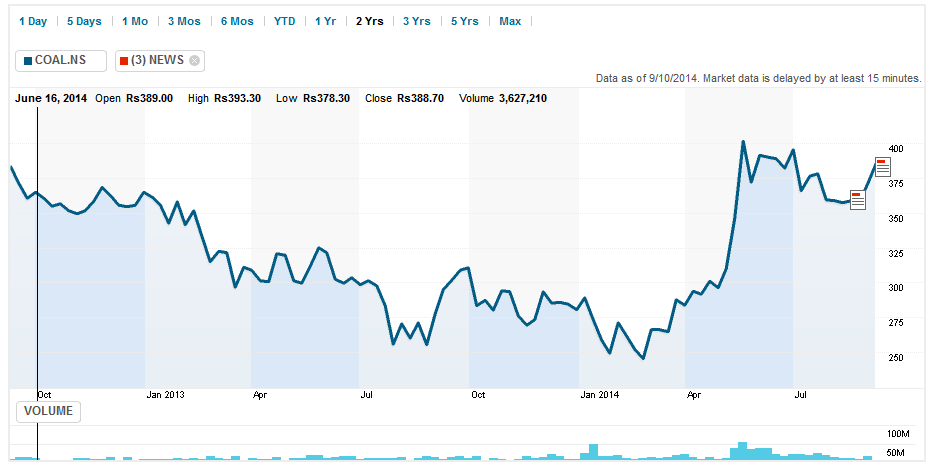
Coal India's share price for the last two years.

Coal India’s share price for the last two years.

One example amongst many illustrates why, quite starkly. Since 2004, the sale of room air-conditioners has grown at about 15% per year, and the industry reported sales of over 3.5 million air-conditioners in 2013. Concerned by the demand for electricity from homes and offices fitted, over the last three years, with new air-conditioners, the Bureau of Energy Efficiency (a statutory body under the Ministry of Power) set out to estimate what effect millions of new air-conditioners would have on peak electricity demand. The answer was provided by an ‘expert group on low carbon strategies for inclusive growth’ for the Planning Commission and independent analysis conducted by the Lawrence Berkeley National Laboratory (of the USA). This study found that peak electricity demand would rise by 75,000 MW to reach 150,000 MW by 2030. That is, in 15 years the peak electricity demand alone will be 60% of today’s total power generation capacity in India!

There is no financial fix and there is no technological fix for such a trend. There is no further excuse for the NDA-BJP government and for ministers like Goyal, Jaitley, Javadekar, Gadkari (and prime minister Modi) to continue to ignore the obvious. Goyal and Jaitley both need an immediate refresher in revisiting the reasons why the marginal cost curve of any action they have announced in the last three months will rise steeply. That rise will be due to a combination of activities, and the natural consequences, which will ruinously amplify the impacts of a changing climate. Bharat cannot continue to shirk the duty – of government and of citizen – of caring first for our ‘prakruti’ (what the west has recently begun to call ecological services) and instead pursuing the ‘maya’ of continuous growth.

– Rahul Goswami

Filed Under: Blogs, Reports & Comment Tagged With: Arun Jaitley, automobiles, BJP, carbon, Climate Change, climate summit, coal, consumption, ecological services, electricity, emissions, energy, energy efficiency, environment, fossil fuel, Goyal, India, Narendra Modi, Nitin Gadkari, oil, oil import, per capita units, power, Prakash Javadekar, prakruriti, UN, urja

Indiaclimate twitter

Tweets by @Indiaclimate

Notable

Between contemplation and climate

Whether or not the USA, Europe, the Western world, the industrialised Eastern world (China, Japan, South Korea, Taiwan), adhere to or not their paltry promises about being more responsible concerning the factors that lead to climate change, is of very little concern to us. We have never set any store by international agreements on climate […]

The ‘Hindu’, ignorant about weather and climate, but runs down IMD

We find objectionable the report by ‘The Hindu’ daily newspaper accusing the India Meteorological Department of scientific shortcoming (‘IMD gets its August forecast wrong’, 1 September 2016). The report claims that the IMD in June 2016 had forecast that rains for August would be more than usual but that the recorded rain was less than […]

dialogue

  • Misreading monsoon | Resources Research on Misreading monsoon
  • Satish on A tribute to the weathermen of Bharat
  • Climate portal editor on A tribute to the weathermen of Bharat
  • Climate portal editor on A tribute to the weathermen of Bharat
  • Climate portal editor on A tribute to the weathermen of Bharat

Categories

Copyright © 2025 indiaclimateportal.org.