The India Climate Observatory

Commentary, action and research on climate and development in India

  • Home
  • About
  • Monsoon 2018
  • Current
  • Bulletin
  • Contact
  • Announcements

MNRE boosts solar thermal use with subsidy

June 10, 2014 by Climate portal editor Leave a Comment

MNRE_Solar_website_201405The Jawaharlal Nehru National Solar Mission is a major initiative of the Government of India and the state governments to promote ecologically sustainable growth while addressing India’s energy security challenge. The Mission, according to the Ministry of New and Renewable Energy, will contribute to the global effort to meet the challenges of climate change.

The first phase (till March 2013) is considered to have achieved the target. The Solar Thermal component of the JNNSM will now, until 2022, focus on promoting off-grid systems including hybrid systems to meet and/or supplement heating and cooling energy requirements and power. These systems still require interventions to bring down costs. The key challenge is to provide an enabling framework and support for entrepreneurs to develop markets. This programme will address off-grid and decentralised solar thermal application area/systems.

Fossil fuels are used for process heating, drying, distillation, water heating, space heating and refrigeration and generation of electricity. The Ministry has estimated that about 25 million households use electric geysers, consuming approximately 7,500 GWh of electricity (assuming minimum annual consumption of around 600 kWh/year/geyser) and 15 million tons a year of petroleum fuels are used in industries in thermal form at temperatures below 300°C. As about 30% of the energy consumed by industry is used for heating water, there is huge potential.

Filed Under: Latest Tagged With: cooling, electric geyser, energy, fossil fuel, heating, JNNSM, MNRE, off-grid, renewable, solar thermal, subsidy

ENSO, ISMR, EQUINOO and rain

June 5, 2014 by Climate portal editor Leave a Comment

RG_ICP_20140605An editorial in the journal Current Science (25 May 2014) has helpfully linked three phenomena that will affect the monsoon of 2014. The first is the El Niño (and the El Niño Southern Oscillation or ENSO) over the Pacific Ocean, considered unfavourable for us and the monsoon. The editorial has pointed out that El Niño has featured in the news already, with likely impacts being considered such as “a decrease of about 1.75% of GDP”. The question the editorial asks is: how reliable is the forecast of an impending El Niño? When it does occur, will it bring a deficit monsoon or a drought inevitably?

The second phenomenon is the Indian summer monsoon rainfall (abbreviated to ISMR by those who study climate for the sub-continent). The Current Science editorial makes an important point which is, studying the relationship between the sufficiency of the monsoon, the GDP and food-grain production during 1950–2004 reveals that the magnitude of the adverse impact of deficit rainfall is much larger than the magnitude of the positive impact of above average rainfall. This means that India being able to predict the possibility of drought (and therefore factors that influence it such as the ENSO) is more important than being able to predict a good monsoon.

The editorial has said that the ISMR “is significantly correlated with this ENSO index, with the relationship explaining 29% of the variance of monsoon rainfall”. Thus the warm phase of ENSO, which is characterised by more rainfall over the equatorial central Pacific, is associated with a decrease in rainfall over India. Now that we know this, what are the implications for monsoon 2014? By April, the warm phase of ENSO has already commenced with enhanced convection/rainfall over the central Pacific and all the models predict that it will amplify and persist until the end of the summer monsoon (the models vary in how they look at linked phenomena and the specific conclusions but agree broadly that El Niño conditions are here.

While the editorial has said that by “mid-June we should get a better idea of whether an El Niño is imminent”, the already unfavourable ENSO conditions mean that the probability of drought has gone up to just over 30%. If an El Niño does fully develop by end-June, the chance of a drought increases to 70%.

The explanation becomes more complete with the assessment of the third phenomenon. This is the Equatorial Indian Ocean Oscillation (EQUINOO). In 2003, it was discovered that in addition to ENSO, EQUINOO plays an important role in the variations, from one year to the next, of the ISMR. There is what is called “a see-saw between a state with enhanced rainfall over western equatorial Indian Ocean and suppressed rainfall over eastern equatorial Indian Ocean” (and its opposite). How this becomes manifest from one year to the next is considered by climatologists to account for about 19% of the variance of the monsoon rainfall.

The equation that we will have to finish writing and balance in the next few weeks is this. During the Indian summer monsoon season, ENSO and EQUINOO are poorly correlated – an ENSO unfavourable to us can be counter-balanced to some degree by a favourable EQUINDO. When both are unfavourable to us, drought has occurred. But the records also show that twice recently, in 1963 and in 1997, a favourable EQUINDO has protected us from the harmful impact of an El Niño. We need, in short, to be watching closely multiple large climatic phenomena every day until at least end-June. Is the IMD up to the job?

Filed Under: Blogs, Latest, Monsoon 2014 Tagged With: 2014, drought, El Nino, ENSO, IMD, Indian Ocean, ISMR, monsoon, Pacific

Holding our breath in India’s cities

May 10, 2014 by Climate portal editor Leave a Comment

On the PM 2.5 scale, India's cities are easily amongst the world's riskiest places in which to live

On the PM 2.5 scale, India’s cities are easily amongst the world’s riskiest places in which to live

The findings by the World Health Organisation on the quality of air in India’s cities are the strongest signal yet to our government (old and new, for the results of the 2014 general election will become known on 16 May) that economic ‘growth’ is a weapon that kills citizens through respiratory tract diseases and infections.

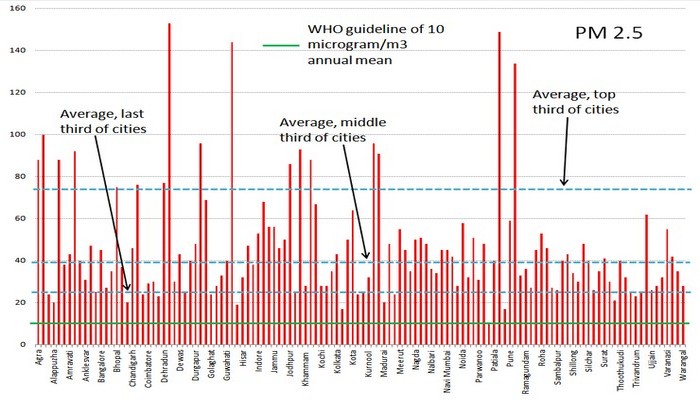
Amongst the 124 Indian cities in the new WHO database on urban air quality worldwide, one city only is at the WHO guideline for PM2.5 and one city only is just above the guidelines for PM10. As a bloc, the quality of air in India’s cities are at alarmingly high levels above the guidelines, above Asian averages (poor as they are, and even considering China’s recklessly poor record) and above world averages.

This is not a singular matter. Already, the WHO has warned that India has a high environmental disease burden, with a significant number of deaths annually associated with environmental risk factors. The Global Burden of Disease for 2010 ranked ambient air pollution as the fifth largest killer in India, three places behind household air pollution. Taken cumulatively, household and ambient air pollution constitute the single greatest risk factor that cause ill health -leading to preventable deaths – in India.

The WHO database contains results of ambient (outdoor) air pollution monitoring. Air quality is represented by ‘annual mean concentration’ (a yearly average) of fine particulate matter (PM10 and PM2.5, which means particles smaller than 10 or 2.5 microns). The WHO guideline values are: for PM2.5 – 10 micrograms/m3 annual mean; for PM10 – 20 micrograms/m3 annual mean. The two charts show just how dangerously above the WHO guidelines the air quality of our cities are.

Without urgent and stringent curbs on the consumption of fuel, Indian cities' PM 10 measures will worsen

Without urgent and stringent curbs on the consumption of fuel, Indian cities’ PM 10 measures will worsen

Half of India’s urban population lives in cities where particulate pollution levels exceed the standards considered safe. A third of this population breathes air having critical levels of particulate pollution, which is considered to be extremely harmful. “We are also running out of ‘clean’ places. Small and big cities are now joined in the pain of pollution,” commented Down To Earth, the environment magazine.

Typically, the official Indian response was to question the WHO findings (these were carried out in the same way in 91 countries, and we don’t hear the other 90 complaining) and to reject them. The reason is easy to spot. Global offender Number One for air pollution amongst world cities is New Delhi, a city that has been pampered as the showcase for what the Congress government myopically calls “the India growth story”.

Hence government scientists are reported to have quickly said that WHO overestimated air pollution levels in New Delhi. “Delhi is not the dirtiest… certainly it is not that dangerous as projected,” said A B Akolkar, a member secretary of the Central Pollution Control Board.

The same recidivist line was parroted by Gufran Beig, chief project scientist at the Indian Institute of Tropical Meteorology (which otherwise does good work on the monsoon and on climate change). He is reported as having said that New Delhi’s air quality was better than Beijing’s, and that pollution levels in winter are relatively higher in New Delhi because of extreme weather events. Beig said: “The value which has been given in this (WHO) report is overestimating (pollution levels) for Delhi … the reality is that the yearly average is around 110 (micrograms).”

The WHO database has captured measurements from monitoring stations located in urban background, residential, commercial and mixed areas. The world’s average PM10 levels by region range from 26 to 208 micrograms/m3, with a world average of 71 micrograms/m3.

PM affects more people than any other pollutant. The major components of PM are sulfate, nitrates, ammonia, sodium chloride, black carbon, mineral dust and water. It consists of a complex mixture of solid and liquid particles of organic and inorganic substances suspended in the air. The most health-damaging particles are those with a diameter of 10 microns or less, which can penetrate and lodge deep inside the lungs. Chronic exposure to particles contributes to the risk of developing cardiovascular and respiratory diseases, as well as of lung cancer.

Central and state governments show no inclination to join the obvious dots. These are, that with more fuels being burned to satisfy the electricity and transport needs of a middle class now addicted to irresponsible consumption, the ‘India growth story’ is what we are choking to death on.

Filed Under: Latest Tagged With: air pollution, black carbon, burden of disease, cancer, electricity, fossil fuel, micrograms, nitrate, particulate matter, PM10, PM2.5, respiratory disease, sulfate, WHO

Weather shock in Kashmir

April 2, 2014 by Climate portal editor Leave a Comment

The Valley of Kashmir, satellite image from National Remote Sensing Centre/Bhuvan

The Valley of Kashmir, satellite image from National Remote Sensing Centre/Bhuvan

Snow up to several feet deep descended on most of the valley of Kashmir in the first two weeks of March, whipping up blizzards and triggering avalanches on the steeper mountain slopes. With at least 17 deaths reported, around 2,000 homes damaged, roads blocked and electricity disrupted in many parts of the state, authorities struggled to rescue people in snowbound areas and restore essential services, as reported by The Third Pole.

The damage to agricultural and horticultural property has yet to be reckoned, said officials, and could run into tens of crores of rupees. The airport in the Jammu and Kashmir summer capital Srinagar had to be closed and highways were blocked. The Himalayan state of Jammu and Kashmir receives 30% of its annual rainfall in the winter. The average rainfall, calculated over the winters of 1951 to 2000, is 183 millimetres (mm). This year, the Indian Meteorological Department forecast that Jammu and Kashmir would see below average rainfall for the months of January through March. And then, between March 1-12, the state received 122 mm of rain, far higher than the normal 56 mm.

Several studies indicate that most parts of the Himalayas are getting warmer at a rate faster than the average warming of the earth. Patterns of rain and snow vary throughout the mountains as weather is controlled by dramatic changes in topography and the presence of distinct microclimates in many parts.

A meteorological department official in Srinagar added that the pattern of rainfall and snowfall was erratic while insufficient precipitation also leaves farmers and others worried. Farmers from southern parts of Kashmir reported that more than 80% of almond crop this year had suffered heavy losses due to the damage caused to almond blossoms. Apple growers in the apple rich belts of Shopian and Sopore said that thousands of apple trees had crumbled under the heavy snow, thus ending any hopes of a good crop. “Around 15% of the apple trees have suffered damage due to the heavy snowfall,” Amin Mir, president of the Kashmir Fruit Growers’ Association, told thethirdpole.net.

Filed Under: Latest Tagged With: Climate Change, Himalaya, Jammu, Kashmir, mountain, Srinagar

First India-China joint study on climate

March 22, 2014 by Climate portal editor Leave a Comment

A woman walks against sand and dust storm in Zhongning county, Northwest China's Ningxia Hui autonomous region in March 2014. Photo: Xinhua

A woman walks against sand and dust storm in Zhongning county, Northwest China’s Ningxia Hui autonomous region in March 2014. Photo: Xinhua

The pre-launch report on the first collaborative India-China study on climate change to be released in Beijing on Monday will generate interest among policy makers and climate watchers, as reported by Hindustan Times.

The title “Low Carbon Development in China and India — Issues and Strategies” is the result of a first-time collaboration between key research institutes in China and India working on issues related to climate change.

“The study examines the main factors in low carbon development – financing, low carbon technologies and on-the-ground implementation – and will encourage greater cooperation between the world’s two largest countries,” said an UNDP official.

China and India are both trying to fight global warming; the low carbon study illustrates some of these efforts and at the same time illustrates some of the current challenges facing both countries, the official added.

The study will help both China and India to share experiences, promote knowledge exchange. At the recently concluded annual session of the National People’s Congress, Premier Li Keqiang, talked about launching a war on pollution in China where coal accounts for a massive share of energy generation.

Filed Under: Daily News, Latest Tagged With: China, climate, global warming, India, low carbon, UNDP

The sun is all he needs for irrigation ,December 3, 2013, The Hindu

December 3, 2013 by Climate portal editor Leave a Comment

Progressive farmer in Gulbarga uses solar energy to operate pump-sets

A progressive farmer in Gulbarga has found a system to use renewable energy to operate irrigation pump-sets, which is expected to help end the dependence on the erratic power supply.

Dattatreya T. Kollur, who used to spend sleepless nights to get three-phase power supply to water his mango and guava orchids and sugarcane fields on his 25-acre land on the outskirts of Deval Gangapur, is now a happy man.

Mr. Kollur and his son Narendra claimed they were the first to install a solar energy plant to power irrigation pump sets.


http://www.thehindu.com/news/national/karnataka/the-sun-is-all-he-needs-for-irrigation/article5415114.ece

Filed Under: Latest

Andhra Pradesh: Cyclone causes heavy damage to crops, November 23, 2013, The Times of India

November 23, 2013 by Climate portal editor Leave a Comment

HYDERABAD: Cyclone Helen, which crossed Andhra Pradesh coast Friday, has damaged crops on over 1.69 lakh hectares, officials said.

The officials have also confirmed six deaths due to the cyclone. Two deaths each were reported from Krishna and East Godavari districts and one each from Srikakulam and West Godavari districts.

Standing paddy crops in the coastal region, known as rice bowl of India, were damaged due to rains triggered by the severe cyclonic storm, which crossed the coast at Machilipatnam.


http://timesofindia.indiatimes.com/india/Andhra-Pradesh-Cyclone-causes-heavy-damage-to-crops/articleshow/26269939.cms

Filed Under: Latest

India and climate talks imperatives,November 18, 2013, The Hindu

November 18, 2013 by Climate portal editor Leave a Comment

India needs an early agreement, and also adequate atmospheric “space” in terms of allowed carbon emissions to pursue its development goals. It needs to take a proactive stance on this

By all accounts, no dramatic developments are to be expected from the 19th edition of the Conference of Parties (COP) of the United Nations Framework Convention on Climate Change (UNFCCC) that started in Warsaw last week. But it is generally acknowledged that the key issue at Warsaw, even if there are many other significant subjects on the agenda, centres around moving forward the negotiations on the Durban Platform for Enhanced Action (DPA) initiated at COP 17 two years ago.

It is widely understood that the Durban Platform was a game-changer, setting the stage for decisive climate action based on clear commitments to emissions reduction from all nations. Subsequently, the discussions in the Ad-Hoc Working Group on the Durban Platform (ADP) have resulted in demanding timeline for achieving its aims, including a draft text to be produced by the COP in 2014, a global meeting of heads of states of all nations to be convened by the United Nations Secretary General to push forward.


http://www.thehindu.com/opinion/lead/india-and-climate-talks-imperatives/article5361115.ece


Filed Under: Latest

India skips mention of natural disasters at climate meet, November 17, 2013, The Economic Times

November 17, 2013 by Climate portal editor Leave a Comment

WARSAW: World may be looking at India for its response to what had happened recently in Odisha and Uttarakhand due to natural disasters which were results of climatic extremes, but there was not a word on these two unfortunate incidents from Indian side, comprising official negotiators, here at the UN climate change conference during the first week of this mega event that would eventually culminate into a global climate deal in Paris in 2015.

Neither the Indian government’s open statement nor the negotiators’ remarks during various rounds of discussions could mention how the country was equally vulnerable to such climate disasters caused by global warming.


http://economictimes.indiatimes.com/environment/global-warming/india-skips-mention-of-natural-disasters-at-climate-meet/articleshow/25953360.cms


Neither the Indian government's open statement nor the negotiators' remarks during various rounds of discussions could mention how the country was equally vulnerable to such climate disasters caused by global warming.

Read more at:
http://economictimes.indiatimes.com/articleshow/25953360.cms?utm_source=contentofinterest&utm_medium=text&utm_campaign=cppst


ARSAW: World may be looking at India for its response to what had happened recently in Odisha and Uttarakhand due to natural disasters which were results of climatic extremes, but there was not a word on these two unfortunate incidents from Indian side, comprising official negotiators, here at the UN climate change conference during the first week of this mega event that would eventually culminate into a global climate deal in Paris in 2015.  Neither the Indian government's open statement nor  ..

Read more at:
http://economictimes.indiatimes.com/articleshow/25953360.cms?utm_source=contentofinterest&utm_medium=text&utm_campaign=cppst

WARSAW: World may be looking at India for its response to what had happened recently in Odisha and Uttarakhand due to natural disasters which were results of climatic extremes, but there was not a word on these two unfortunate incidents from Indian side, comprising official negotiators, here at the UN climate change conference during the first week of this mega event that would eventually culminate into a global climate deal in Paris in 2015.  Neither the Indian government's open statement nor ..

Read more at:
http://economictimes.indiatimes.com/articleshow/25953360.cms?utm_source=contentofinterest&utm_medium=text&utm_campaign=cppst

WARSAW: World may be looking at India for its response to what had happened recently in Odisha and Uttarakhand due to natural disasters which were results of climatic extremes, but there was not a word on these two unfortunate incidents from Indian side, comprising official negotiators, here at the UN climate change conference during the first week of this mega event that would eventually culminate into a global climate deal in Paris in 2015.  Neither the Indian government's open statement nor ..

Read more at:
http://economictimes.indiatimes.com/articleshow/25953360.cms?utm_source=contentofinterest&utm_medium=text&utm_campaign=cppst

WARSAW: World may be looking at India for its response to what had happened recently in Odisha and Uttarakhand due to natural disasters which were results of climatic extremes, but there was not a word on these two unfortunate incidents from Indian side, comprising official negotiators, here at the UN climate change conference during the first week of this mega event that would eventually culminate into a global climate deal in Paris in 2015.  Neither the Indian government's open statement nor ..

Read more at:
http://economictimes.indiatimes.com/articleshow/25953360.cms?utm_source=contentofinterest&utm_medium=text&utm_campaign=cppst

Filed Under: Latest

Developing countries call for easing IPR costs of clean technologies, November 15, 2013, The Hindu

November 15, 2013 by Climate portal editor Leave a Comment


The issue of easing the costs of intellectual property resources on clean technologies takes centre stage

For the developed countries it was a devil buried at the climate negotiations last year at Doha. At the Warsaw talks, the developing countries, including India, resuscitated the devil — easing the costs of intellectual property rights (IPR) on clean technologies — back to life, by demanding that a funding mechanism be set up to buy licenses on clean but costly technologies to provide to the poor countries.


The topic of intellectual property rights has been such a hot potato for the developed countries that at the climate talks last year, developing countries had to agree to back-burner it in order to build consensus.


Bringing the topic right back to the centre-stage again at Warsaw, the Egyptian lead negotiator, speaking for the Like Minded Developing Countries, said: “Like the Harry Potter series character, in Doha, IPR was the ‘word which should not be named’. But we live in the real world not in a fictional world. In this real world we live in, we need to address this issue of IPRs in a pragmatic manner, not run away from this issue.”

http://www.thehindu.com/sci-tech/energy-and-environment/developing-countries-call-for-easing-ipr-costs-of-clean-technologies/article5355065.ece

Filed Under: Latest

  • « Previous Page
  • 1
  • …
  • 3
  • 4
  • 5
  • 6
  • 7
  • …
  • 88
  • Next Page »

Indiaclimate twitter

Tweets by @Indiaclimate

Notable

Between contemplation and climate

Whether or not the USA, Europe, the Western world, the industrialised Eastern world (China, Japan, South Korea, Taiwan), adhere to or not their paltry promises about being more responsible concerning the factors that lead to climate change, is of very little concern to us. We have never set any store by international agreements on climate […]

The ‘Hindu’, ignorant about weather and climate, but runs down IMD

We find objectionable the report by ‘The Hindu’ daily newspaper accusing the India Meteorological Department of scientific shortcoming (‘IMD gets its August forecast wrong’, 1 September 2016). The report claims that the IMD in June 2016 had forecast that rains for August would be more than usual but that the recorded rain was less than […]

dialogue

  • Misreading monsoon | Resources Research on Misreading monsoon
  • Satish on A tribute to the weathermen of Bharat
  • Climate portal editor on A tribute to the weathermen of Bharat
  • Climate portal editor on A tribute to the weathermen of Bharat
  • Climate portal editor on A tribute to the weathermen of Bharat

Categories

Copyright © 2026 indiaclimateportal.org.